
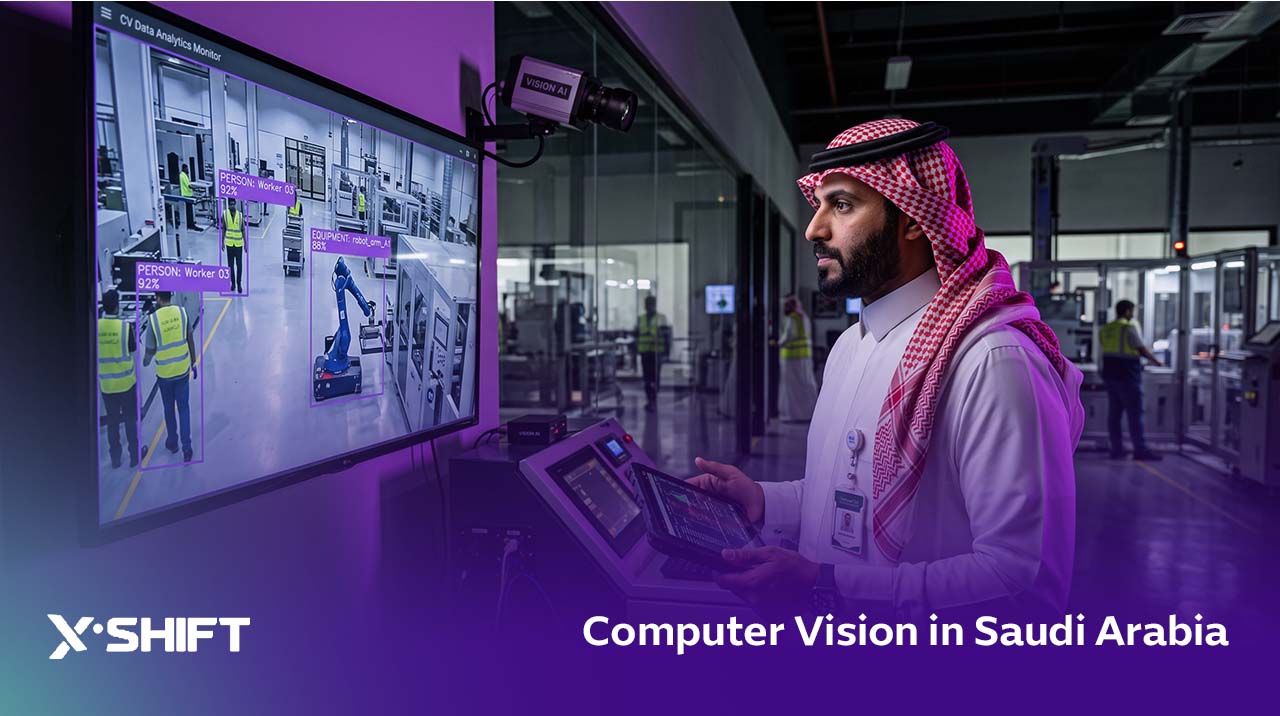
Computer Vision in Saudi Arabia: AI Video Analytics Platform
Organizations across the Kingdom are increasingly looking for smarter ways to improve safety, monitor operations, understand movement, and respond to events in real time. Computer Vision Saudi Arabia is emerging as a practical application of artificial intelligence that turns existing video streams into actionable operational intelligence. X-Shift supports this shift through X-View, its AI-powered computer vision platform designed to help organizations move beyond passive surveillance toward automated detection, faster response, and data-driven visual insights.
What Is Computer Vision in Saudi Arabia?
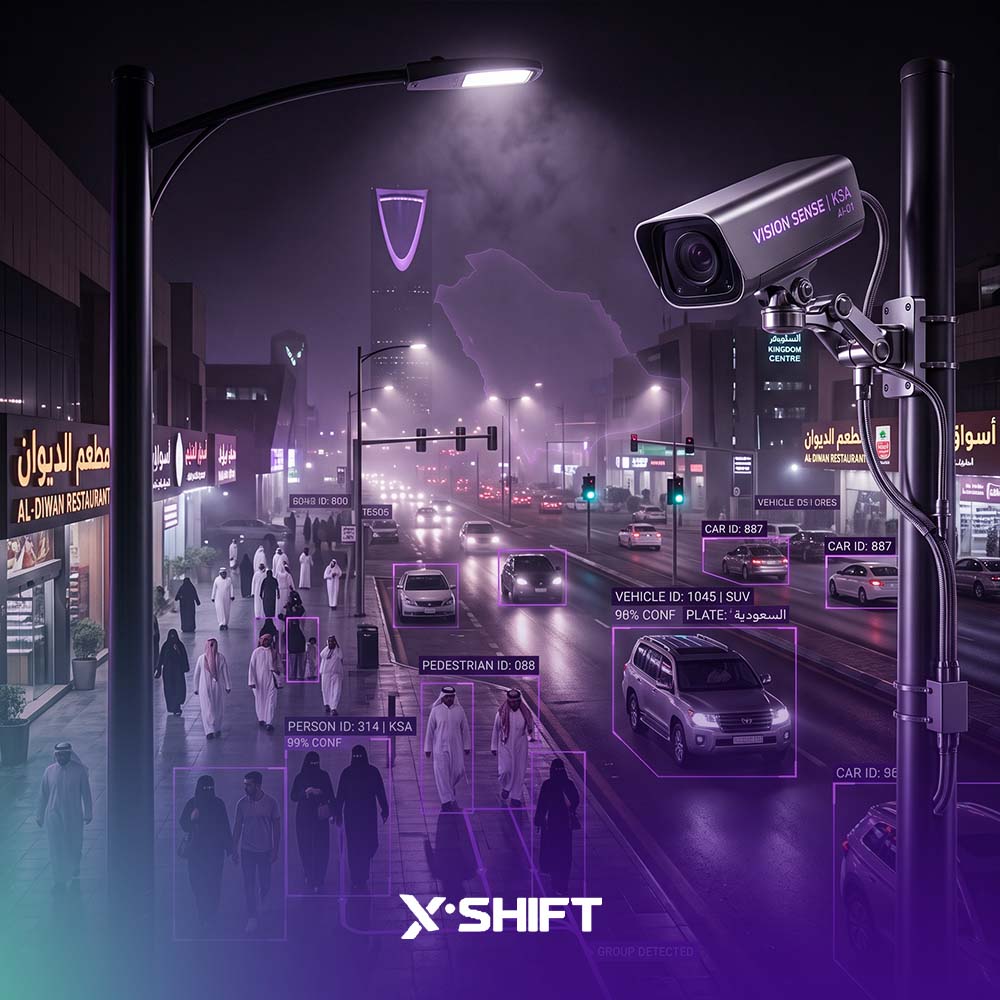
Computer Vision in Saudi Arabia refers to the use of artificial intelligence to analyze images and video so systems can recognize objects, behaviors, events, movement, and operational conditions automatically. Instead of relying only on people to watch camera feeds or review footage after an incident, computer vision models can continuously interpret visual information and trigger alerts, dashboards, or workflows when predefined conditions are detected.

Turning Video Into Actionable Data
Computer Vision Saudi Arabia helps organizations treat camera feeds as a source of structured operational information rather than unorganized video. AI models can identify people, vehicles, objects, zones, behaviors, and events, then convert those observations into data that can be measured and analyzed. This makes it possible to understand what is happening across a site without requiring employees to manually review every camera or every hour of recorded footage.
Moving Beyond Traditional Surveillance
Traditional surveillance systems are mainly designed to record events for later review. Modern CCTV AI analytics adds an intelligence layer that can analyze what is happening while the event is taking place. This allows organizations to detect predefined risks, unusual activity, safety violations, or operational deviations much earlier. The result is a more proactive model in which video can support immediate decisions instead of serving only as evidence after an incident.
Why Is Computer Vision Important for Saudi Organizations?
Computer vision can support organizations operating complex physical environments where safety, movement, compliance, and operational visibility matter. As highlighted in the latest insights on CX trends in Saudi Arabia, smart cities, industrial facilities, retail spaces, transportation environments, and large public sites all generate significant amounts of visual information. AI-based video analysis can help these organizations extract practical insight from existing camera infrastructure while reducing dependence on continuous manual monitoring.
Improving Safety and Risk Detection
Computer Vision in Saudi Arabia can support safety teams by identifying conditions that match predefined risk scenarios. Depending on the use case, this may include restricted-area access, unsafe behavior, missing protective equipment, abnormal movement, or other visual events. Faster detection can help organizations respond before a minor issue becomes a larger incident, while event logs provide useful information for reviewing patterns and improving preventive safety measures.
Strengthening Operational Visibility
Large facilities can be difficult to monitor consistently because people and assets move across multiple areas throughout the day. Computer Vision Saudi Arabia can help operations teams understand movement, traffic, occupancy, queue conditions, and activity patterns across physical spaces. This information can support better planning, resource allocation, and process improvement while reducing the need to depend entirely on manual observation or periodic site inspections.
Supporting Faster Response
When visual events are detected automatically, alerts can be routed to the people or systems responsible for taking action. Computer Vision Saudi Arabia can therefore shorten the gap between an event occurring and the organization becoming aware of it. Notifications, dashboards, integrations, or automated workflows can help teams respond more quickly, especially in environments where delays may affect safety, customer experience, or operational continuity.
Where Can Computer Vision Be Used?
The value of visual intelligence depends on the environment and business problem being addressed. The technology can be applied wherever cameras already capture important operational activity and teams need faster understanding of what those cameras see. The most effective implementations begin with a clearly defined use case, measurable outcome, and operational response rather than deploying AI simply because video data is available.
Smart Cities and Government
Computer Vision in Saudi Arabiacan support government digital transformation initiatives through applications such as traffic observation, public safety monitoring, infrastructure visibility, road condition analysis, and management of high-activity public environments. When visual data is connected with command centers and operational systems, teams can gain faster awareness of events and patterns that would otherwise require extensive manual monitoring across large geographic areas.
Manufacturing and Industrial Facilities
Industrial environments often have strict safety and operational requirements. Computer Vision Saudi Arabia can help monitor defined zones, safety practices, asset movement, inspections, and operational conditions. Visual intelligence can complement existing safety programs by creating automated detection for selected scenarios and generating event history that can be used to identify recurring risks, review compliance trends, and improve procedures across facilities.
Retail and Commercial Spaces
Retailers and commercial operators can leverage specialized computer vision in retail solutions to better understand how people move through physical spaces, where congestion occurs, and how different areas are used. Computer Vision Saudi Arabia can support operational analysis while also helping teams detect selected safety or security events. When used with appropriate governance, these insights can improve space planning, queue management, staffing decisions, and the overall efficiency of physical locations.

How Does AI-Powered Computer Vision Work?
AI-powered computer vision typically follows a workflow that begins with a video source and ends with an operational action or insight, forming a core element of broader AI automation for business. Existing cameras can provide streams to trained AI models, which analyze frames for predefined objects, events, behaviors, or conditions. The results can then appear in dashboards, create alerts, integrate with other systems, or be stored for trend analysis and continuous operational improvement.
Connecting Existing Camera Sources
Organizations do not always need to replace their camera infrastructure to introduce visual intelligence. Computer Vision Saudi Arabia solutions can often connect to existing video sources, depending on technical compatibility and deployment requirements. This can reduce implementation disruption and allow organizations to build on investments they have already made. The focus then shifts from simply capturing footage to extracting useful intelligence from the video already available.
Detecting Objects, Events, and Patterns
AI models analyze visual streams to identify specific conditions defined by the use case. Computer Vision Saudi Arabia can be configured around objects, zones, movement, behaviors, or operational rules. Leveraging advanced Agentic AI solutions in Saudi Arabia, the quality of the result depends on factors such as the camera environment, model selection, scenario definition, and testing. A well-designed implementation should focus on reliable detection that supports a clear operational decision rather than producing excessive alerts without context.
Triggering Alerts and Workflows
The real value of visual intelligence appears when detection leads to action. Computer Vision Saudi Arabia can connect events with alerts, dashboards, messaging channels, or enterprise systems so the right team receives relevant information quickly. Organizations can define escalation rules based on severity or scenario type, helping ensure that important events receive attention while routine observations remain available for reporting and analysis.
What Are the Business Benefits of Computer Vision?
Computer vision can create value by improving visibility across environments that are difficult to monitor manually. It can support faster detection, more consistent oversight, and better use of video data that organizations already generate. These innovations play a central role in driving AI for business growth, particularly when connected to measurable outcomes such as reduced response time, fewer safety violations, better operational control, or improved utilization of physical assets and spaces.
Reducing Manual Monitoring
Continuous camera monitoring can require significant human effort, particularly across large sites with many video feeds. AI can help prioritize events that require attention instead of expecting employees to watch every screen continuously. This allows monitoring teams to focus on higher-value investigation and response activities. It can also provide more consistent coverage across periods when attention may otherwise vary due to workload or the number of simultaneous feeds.
Improving Preventive Operations
Visual intelligence can help organizations identify recurring conditions before they become larger problems. Computer Vision Saudi Arabia allows teams to review event patterns, understand where incidents occur most frequently, and examine how physical environments are being used. These insights can inform preventive actions such as changing layouts, updating procedures, improving signage, adjusting staffing, or redesigning specific operational areas.
Creating Measurable Visual Insights
Video contains information about movement, behavior, utilization, and events, but traditional systems often leave that information locked inside recordings. Computer Vision Saudi Arabia turns selected visual observations into structured data that can be tracked over time. Dashboards and industry reports can then help managers identify trends, compare locations or periods, and incorporate visual intelligence into wider operational decision-making.
How Should Organizations Implement Computer Vision?
A successful implementation requires clear business objectives, suitable camera coverage, reliable models, integration planning, and governance. Organizations should align visual AI with their overarching digital transformation strategy. Projects should begin with specific scenarios where visual detection can support a measurable operational outcome. Starting with focused use cases also makes it easier to test accuracy, understand false positives, refine workflows, and demonstrate value before expanding the technology across more sites or processes.
Start With High-Value Use Cases
Organizations should identify situations where faster detection or better visual visibility would produce clear value. Examples may involve safety, access, operational movement, inspection, or customer flow. Before rolling out large-scale deployments, assessing organizational readiness through a digital readiness assessment or using a digital maturity assessment platform can help test whether camera placement, AI models, and response workflows work effectively together.
Integrate With Existing Operations
Visual intelligence should fit into the organization’s existing processes rather than create a separate monitoring environment that teams must manage independently. Computer Vision Saudi Arabia can be more effective when events connect with command centers, building systems, video management platforms, mobile applications, or other enterprise tools like CRM and ticketing systems. Integration ensures that detected events reach people who can act and that visual insight becomes part of normal operations.
Establish Governance and Security
Video can involve sensitive environments and information, so organizations need clear policies around access, retention, permissions, deployment, and data protection. Robust governance must also complement essential network monitoring services to guarantee uptime and security from the beginning, including encryption and role-based access where appropriate. Governance should also define which use cases are permitted, who owns the system, how models are reviewed, and how detected events are handled operationally.
How X-Shift Supports Computer Vision Saudi Arabia With X-View
X-Shift delivers Computer Vision Saudi Arabia capabilities through X-Vibe and its dedicated computer vision solutions, featuring the X-View AI-powered video intelligence platform. X-View is designed to work with existing camera environments and analyze video for objects, behaviors, events, risks, and operational patterns. It supports real-time detection, automated alerts, dashboards, and integrations, helping organizations move from passive video recording toward proactive visual intelligence and faster operational decision-making.
Real-Time Visual Intelligence
X-View analyzes video using trained computer vision models to detect predefined situations and patterns. The platform is positioned around real-time accuracy and automated monitoring, allowing organizations to identify selected risks, violations, or operational deviations as they occur. This helps reduce the delay associated with manual review and gives operational teams a clearer way to focus attention on events that may require immediate action.
Integration With Existing Environments
X-View is designed to integrate with existing enterprise environments and supports deployment on-premise or in the cloud. X-Shift also highlights API-first integration with systems such as BMS, VMS, command centers, and mobile applications, as well as broader smart business solutions. This helps organizations introduce visual intelligence without treating it as an isolated system and allows detected events to feed into broader operational workflows and response processes.
Visual Intelligence Across Multiple Sectors
X-Shift positions X-View for environments including smart cities and government, manufacturing and industrial facilities, and retail or commercial spaces. These sectors often rely heavily on video while also requiring fast operational decisions. To explore full platform capabilities, check our complete suite of CX solutions or learn more about X-Shift.
For organizations looking to transform existing camera infrastructure into a source of real-time operational intelligence, X-Shift can help deploy Computer Vision Saudi Arabia capabilities through X-View to support faster detection, stronger visibility, automated response, and more informed decision-making across physical environments. Discover more insights on our blogs page or contact us today to start your transformation, or visit our careers page to join our team.