
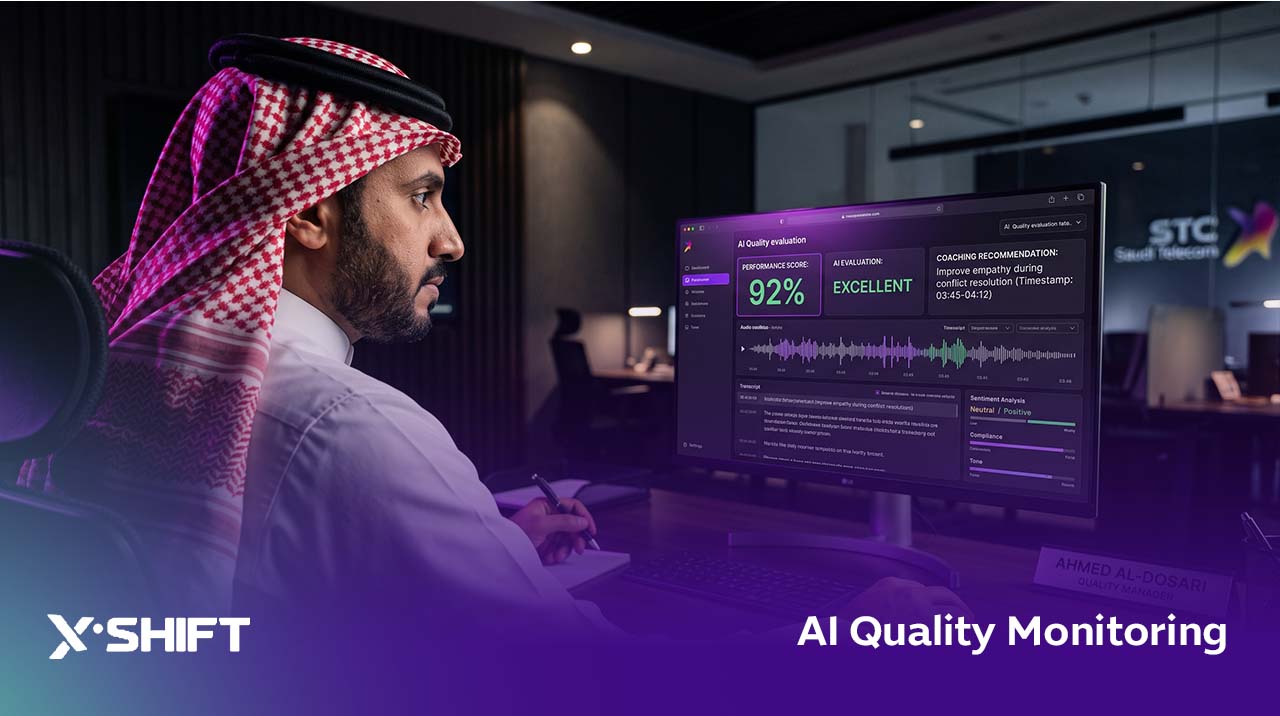
AI Quality Monitoring: Turn Contact Center Quality Assurance into Strategy
Contact centers handle thousands of customer interactions across voice, chat, email, and digital channels, yet traditional quality assurance often reviews only a small sample. AI Quality Monitoring changes this model by using artificial intelligence to evaluate interactions at scale, identify risks, measure agent performance, and surface coaching opportunities. X-Shift supports this approach through X-Vibe, its automated quality monitoring solution designed to turn customer conversations into real-time quality, compliance, and experience intelligence.
What Is AI Quality Monitoring?
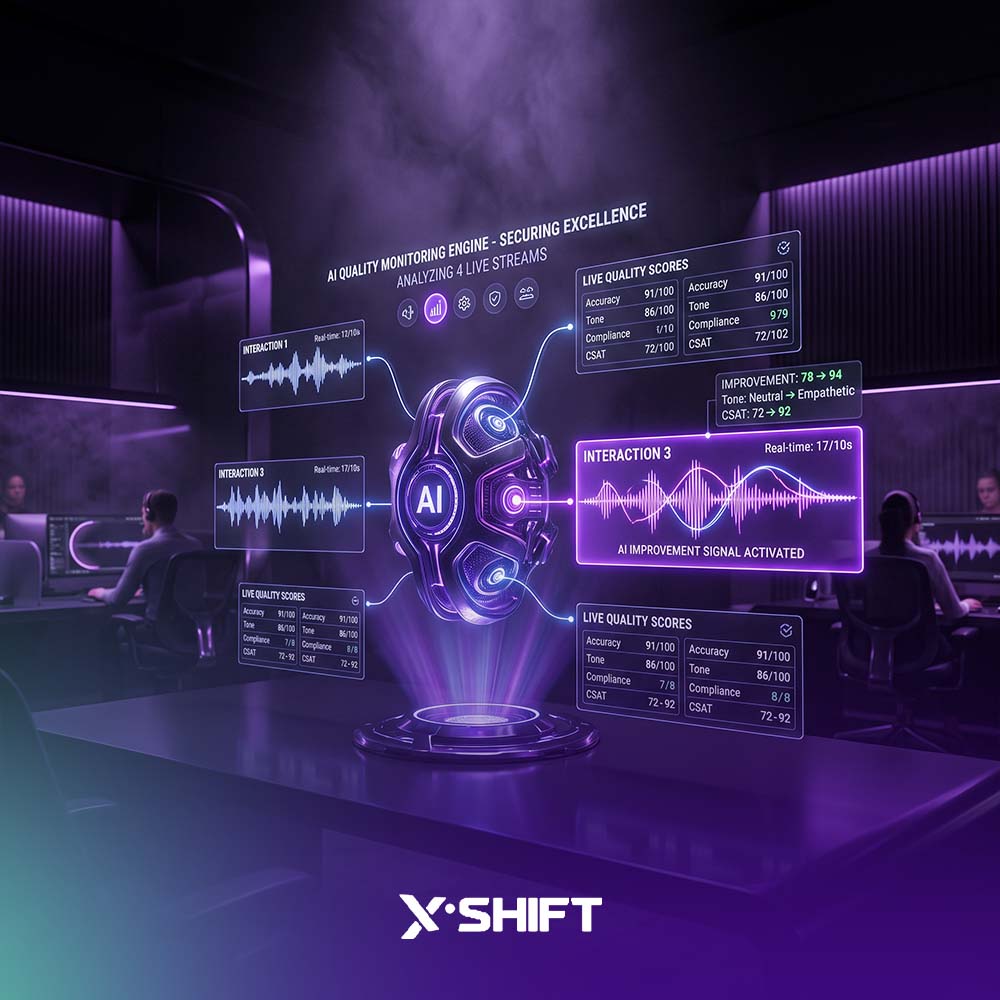
AI Quality Monitoring is the use of artificial intelligence to analyze customer interactions and evaluate them against defined quality, compliance, and service criteria. Instead of relying entirely on manual review, the system can transcribe conversations, detect sentiment, identify intent, score interactions, and flag potential issues. This gives quality teams a broader and more consistent view of performance while reducing the time required to review large volumes of conversations manually.

Automated Interaction Evaluation
AI Quality Monitoring can assess conversations against predefined scorecards, service standards, and compliance rules. The system can look for required statements, customer handling behaviors, escalation signals, or process steps and then generate a structured evaluation. This makes quality review more consistent because the same criteria can be applied across a much larger number of interactions instead of depending on a limited sample selected by individual evaluators.
Sentiment and Intent Analysis
Customer tone and intent can reveal problems that are not obvious from a simple quality score. AI Quality Monitoring can analyze conversation language to identify frustration, satisfaction, escalation risk, or the reason behind the contact. These insights help supervisors understand not only whether an agent followed the process, but also how the customer experienced the interaction and where service design or communication may need improvement.
Why Do Contact Centers Need AI Quality Monitoring?
Traditional quality assurance can be difficult to scale because manual reviewers need time to listen to calls, complete scorecards, document findings, and provide feedback. AI Quality Monitoring allows organizations to expand coverage without increasing manual review effort at the same rate. It also provides faster visibility into recurring issues, helping contact centers move from delayed quality reporting toward more proactive performance and risk management within their omnichannel customer contact centre operations.
Expanding Quality Coverage
Manual QA usually evaluates only a fraction of total interactions, which means important patterns can remain hidden. AI Quality Monitoring can analyze a much larger share of conversations and provide a more representative picture of performance. Broader coverage helps organizations identify issues that may not appear in a small sample, including inconsistent service behaviors, repeated customer frustrations, compliance gaps, or recurring process failures across teams and channels.
Reducing Evaluation Inconsistency
Different evaluators can interpret the same conversation differently, especially when quality criteria are complex or subjective. AI Quality Monitoring can apply the same scoring logic to every interaction, creating a more standardized baseline for comparison. Human reviewers still play an important role in calibration and judgment, but automated evaluation can reduce unnecessary variation and give quality teams more consistent data for coaching, reporting, and operational improvement.
Detecting Problems Earlier
Traditional QA often identifies an issue days after the interaction occurred. AI Quality Monitoring can surface high-risk conversations, missed compliance steps, or strong negative sentiment much sooner. Faster visibility gives supervisors an opportunity to intervene, review the case, contact the customer when necessary, or coach the agent before the same problem repeats across many additional interactions.
What Can AI Analyze in Customer Interactions?
The capabilities of automated quality analysis extend beyond checking whether an agent followed a script. Modern systems can analyze multiple dimensions of the conversation, including language, sentiment, intent, silence, interruptions, compliance statements, and escalation signals. This creates a richer view of quality and allows contact centers to connect agent behavior with digital customer experience, operational risk, and business outcomes.
Quality Scorecards and Service Standards
A contact center can define scorecards that reflect its own service standards, policies, and quality framework. AI Quality Monitoring can evaluate each interaction against those criteria and generate comparable scores across agents, teams, and channels. This helps managers understand where performance is strong and where specific behaviors require improvement, while also making it easier to track trends over time rather than relying on isolated audit results through detailed call center analytics.
Compliance and Policy Adherence
Many contact centers need to verify that agents follow required processes or deliver mandatory disclosures. AI Quality Monitoring can identify whether specific statements, verification steps, or policy requirements were completed during an interaction. When a possible gap is detected, the system can flag it for review or trigger a workflow, giving compliance teams faster visibility into potential risks and reducing dependence on random manual sampling.
Agent Coaching Opportunities
Quality data is most valuable when it leads to better performance. The system can highlight specific moments where an agent handled a conversation well or where improvement may be needed, such as empathy, interruption handling, product knowledge, or escalation management. Supervisors can use these insights to deliver more targeted coaching rather than relying on general feedback that may not address the exact behavior affecting customer experience.
How Does AI Quality Monitoring Improve Customer Experience?
AI Quality Monitoring helps contact centers connect quality assurance with customer experience by analyzing what happens during real interactions at scale. It can reveal repeated frustrations, long periods of silence, unnecessary transfers, missed expectations, or poor communication patterns. Integrating these insights with a CRM and ticketing system allows organizations to improve agent behavior and examine whether the underlying process, policy, or service journey is creating avoidable customer effort.
Identifying Customer Friction
Repeated complaints and negative sentiment often point to problems beyond individual agent performance. Automated analysis can aggregate patterns across conversations to show where customers are consistently struggling. By leveraging Voice of Customer (VoC) research, customer experience teams can focus on fixing root causes rather than treating every difficult conversation as an isolated case.
Improving Resolution Quality
A fast interaction is not necessarily a successful one if the customer needs to contact the organization again. Automated quality analysis can help teams evaluate whether agents provided complete information, followed the correct process, and handled the customer effectively. This broader view supports better first-contact resolution and helps managers balance efficiency measures such as handling time with the actual quality of the outcome to improve customer experience continuously.
Supporting More Consistent Service
Customers expect a similar standard of service regardless of which agent or channel they use. Automated quality tools can help organizations compare interactions against shared quality criteria and identify variations between teams. When quality leaders can see these differences clearly, they can update knowledge, refine procedures, adjust training, and provide focused coaching that improves consistency across the customer service operation, while learning how to create an omnichannel strategy for a seamless customer journey.

How Should Organizations Implement AI Quality Monitoring?
Successful implementation requires more than turning on an AI model. Organizations should define quality standards, prepare scorecards, identify priority use cases, integrate relevant channels, and calibrate automated results with experienced reviewers. Implementing advanced smart business solutions ensures technology works best when quality teams treat it as a decision-support capability that complements human expertise, governance, and continuous improvement.
Define Clear Quality Criteria
Before automation begins, the organization should agree on what good service looks like. AI Quality Monitoring needs clear scorecards, policy rules, behavioral expectations, and escalation criteria to produce useful evaluations. Quality, compliance, customer experience, and operations teams should align on these definitions so automated scoring reflects business priorities and does not simply measure what is easy for the technology to detect.
Calibrate AI With Human Review
Automated scoring should be tested and calibrated against experienced human evaluators before it becomes a primary source of performance information. Teams can compare AI results with manual assessments, investigate differences, and refine scoring logic. This aligns with broader AI automation for business strategies to build trust in the system and help organizations determine which decisions can be automated and which still require human review.
Connect Insights to Action
The value of automated quality analysis increases when findings automatically lead to the right next step. High-risk interactions may trigger supervisor alerts, compliance issues may create review cases, and coaching opportunities may be added to an agent development workflow. Connecting insight with action prevents quality data from remaining in dashboards and helps the organization respond more quickly to the issues that matter most.
How X-Shift Supports AI Quality Monitoring With X-Vibe
X-Shift delivers AI Quality Monitoring through X-Vibe, its automated quality intelligence platform for customer interactions. X-Vibe evaluates conversations across channels, applies AI scoring, analyzes sentiment and intent, detects compliance gaps, and surfaces escalation risk. It also supports automated alerts, coaching workflows, reporting, and integration with contact center and CRM environments, helping organizations move from limited manual QA toward broader and more proactive quality operations.
Automated Quality Evaluation at Scale
X-Vibe is designed to evaluate interactions against organization-specific quality rubrics and compliance rules. It can transcribe voice conversations, score interactions, analyze sentiment, and aggregate trends across teams. This allows quality leaders to gain visibility across a much larger share of customer conversations and spend less time on repetitive auditing, while focusing more attention on coaching, root-cause analysis, and quality strategy.
Real-Time Risk and Compliance Intelligence
X-Vibe can identify signals such as escalation risk, missed compliance requirements, sentiment changes, and other high-risk interaction patterns. The platform can then trigger alerts and related workflows so supervisors or compliance teams can respond quickly. X-Shift also offers Arabic-first conversational AI technology designed to understand Saudi dialect and mixed Arabic-English customer conversations, making it particularly relevant for local contact center environments.
Analytics, Coaching, and Integration
The platform provides dashboards and reporting for quality, compliance, risk, and agent performance, while also supporting AI-generated coaching linked to specific interaction moments. It can connect with contact center, CRM, and digital environments through APIs, webhooks, and connectors. In addition, deploying advanced voice and chat bots allows organizations to integrate automated quality intelligence into existing operations rather than creating a separate quality workflow disconnected from AI customer service systems.
For organizations seeking to increase QA coverage, identify customer risks earlier, improve coaching, and build more consistent service standards, X-Shift can help deploy AI Quality Monitoring through X-Vibe as part of a broader digital CX transformation services strategy, alongside comprehensive managed services and managed IT services.