
What Is Knowledge Management in Saudi Arabia?
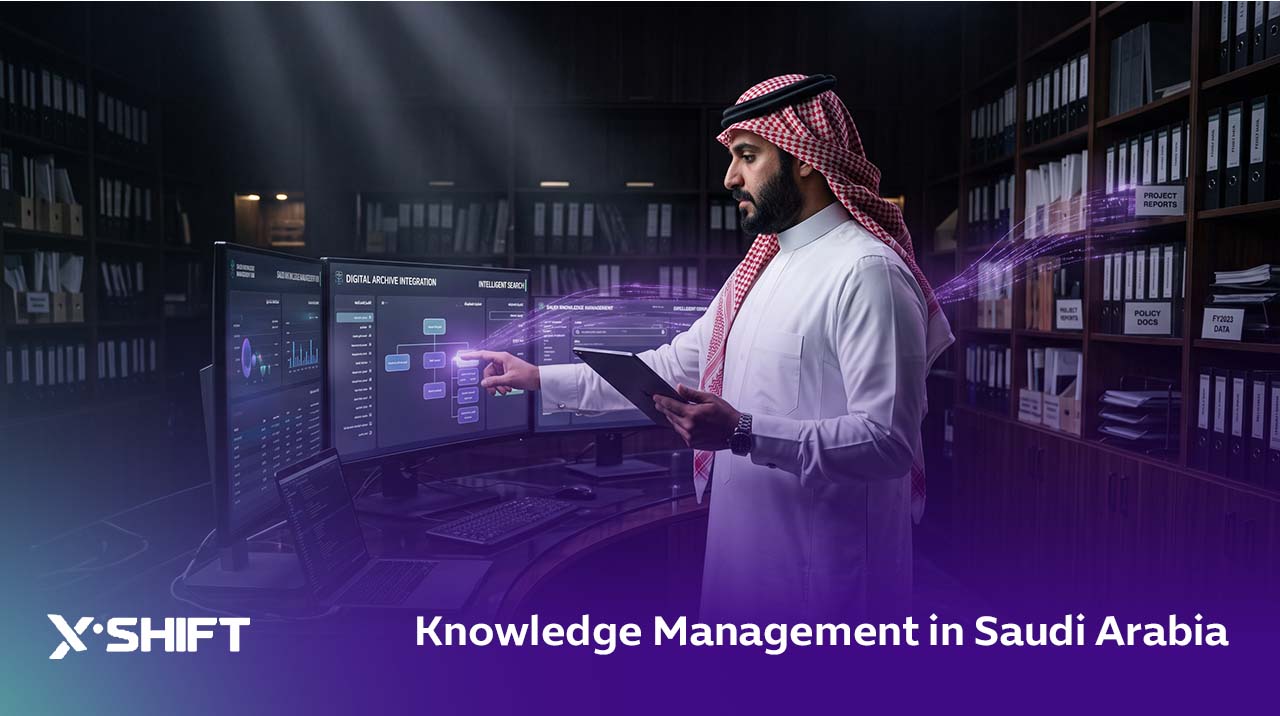
Organizations across the Kingdom are generating more information than ever through policies, procedures, customer interactions, digital services, internal documentation, and employee expertise. Knowledge Management Saudi Arabia helps businesses and public entities turn this growing volume of information into a structured operational asset. X-Shift supports organizations with AI-powered knowledge management capabilities that centralize enterprise knowledge, improve access to accurate information, and connect knowledge with customer service and digital workflows.
What Is Knowledge Management in Saudi Arabia?
Knowledge Management in Saudi Arabia refers to the structured process of capturing, organizing, maintaining, sharing, and applying institutional knowledge within organizations operating in the Kingdom. The goal is to ensure that employees and customers can access the right information at the right time, while reducing dependence on scattered documents, individual experience, or disconnected systems. A strong knowledge environment supports faster decisions, more consistent service, and better organizational learning.

Centralizing Institutional Knowledge
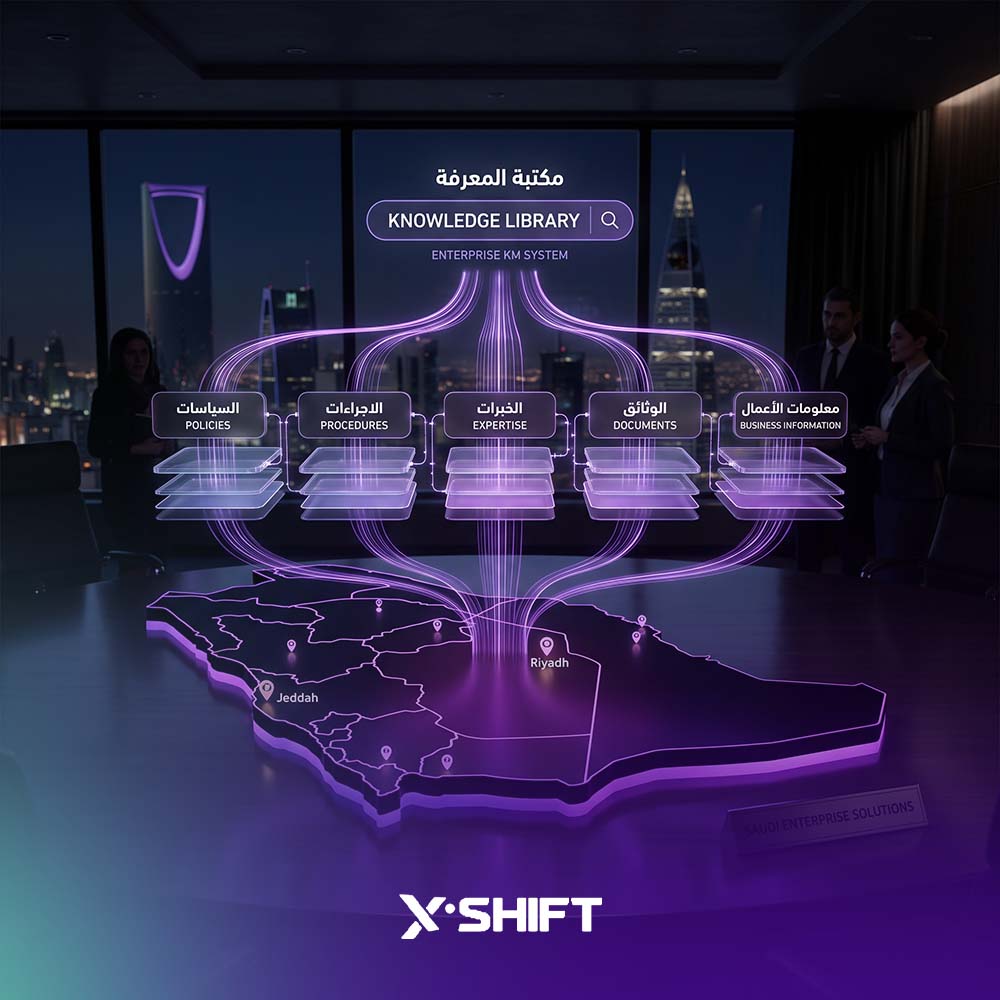
Knowledge Management Saudi Arabia helps organizations bring FAQs, policies, procedures, service guides, manuals, and operational instructions into one governed environment. Centralization reduces the time employees spend searching across folders, emails, and multiple platforms. It also makes it easier to identify outdated or duplicated content, assign ownership, and ensure that critical information remains available even when experienced employees change roles or leave the organization.
Improving Access to Accurate Information
Employees often lose time when they cannot quickly find the information required to complete a task or answer a customer. Knowledge Management Saudi Arabia improves information discovery by organizing content around real business needs and making approved knowledge easier to search. When teams can access reliable answers without navigating several systems, they can work more efficiently and provide more consistent responses across departments, branches, and service channels.
Why Knowledge Management in Saudi Arabia Matters for Organizations
Knowledge Management in Saudi Arabia is becoming increasingly important as organizations expand digital services, automate processes, and manage larger volumes of information. Without structured knowledge, digital transformation can create more systems without solving the underlying problem of fragmented information. A strong knowledge management strategy helps connect people, processes, and technology so that information can be reused effectively rather than recreated repeatedly by different teams.
Supporting Digital Transformation
Knowledge Management Saudi Arabia provides an important foundation for digital transformation because automated workflows, self-service, AI chatbots and virtual assistants, and customer service platforms all depend on accurate and accessible information. If procedures are outdated or knowledge is scattered, digital tools may deliver inconsistent results. By organizing and governing knowledge first, organizations create a stronger base for automation, intelligent search, and more reliable digital services.
Preserving Organizational Expertise
Knowledge often exists in the experience of individual employees rather than formal systems. When these employees retire, transfer, or leave, valuable operational understanding can disappear with them. Knowledge Management Saudi Arabia helps organizations document expertise, capture proven practices, and convert individual know-how into reusable institutional knowledge. This reduces operational dependency on specific people and supports smoother onboarding, succession, and continuity across teams.
Improving Customer Service Consistency
Customer-facing employees need clear and reliable information to provide accurate answers. Knowledge Management Saudi Arabia enables organizations to use approved procedures, troubleshooting guides, product information, and service policies as a common source of truth. This reduces conflicting answers between agents and channels, improves customer experience, and helps contact center teams resolve requests more efficiently without repeatedly escalating basic questions to specialists.
What Are the Core Components of Effective Knowledge Management?
A successful knowledge management program combines content, governance, technology, search, workflow integration, and continuous improvement. Knowledge Management Saudi Arabia should not be treated as a document storage project. The objective is to create a living knowledge environment in which information is easy to create, review, discover, update, and apply. The following components help organizations build a platform that employees will actually use.
Centralized Knowledge Base
A centralized knowledge base brings essential organizational information into one accessible location. It can include support articles, FAQs, internal policies, operating procedures, product documentation, and training materials. The platform should make content easy to categorize and maintain while supporting permissions for different audiences. Centralization also gives knowledge owners greater visibility into duplicated content, missing topics, and documents that require regular review.
Decision Trees and Guided Workflows
Knowledge Management in Saudi Arabia can go beyond static articles by using decision trees and guided workflows that help employees navigate complex procedures step by step. This is particularly useful in customer service environments where agents must choose the correct action based on several conditions. Guided knowledge reduces uncertainty, supports faster resolutions, and helps newer employees follow approved procedures without relying entirely on memory or informal advice from colleagues.
AI-Powered Search and Insights
AI can make knowledge easier to discover by interpreting user intent and connecting related information even when exact keywords are not used. Knowledge Management Saudi Arabia can also benefit from analytics that reveal popular searches, failed searches, frequently used content, and information gaps. These insights help knowledge teams understand what employees and customers actually need and continuously improve the quality and relevance of the repository through advanced AI for business growth tools.

How Does Knowledge Management Improve Customer Experience?
Knowledge Management in Saudi Arabia has a direct impact on customer experience because service quality often depends on how quickly employees can find accurate answers. Customers expect consistent information whether they interact through phone, chat, email, or self-service channels. A connected knowledge environment helps ensure that all channels rely on the same approved information, reducing confusion and making customer journeys more predictable through customer journey optimization.
Faster Customer Resolutions
When agents can find the right answer immediately, they spend less time placing customers on hold, transferring cases, or searching through multiple resources. A strong knowledge base can guide agents toward the correct procedure while they are handling the interaction. This helps shorten resolution time and improves the customer’s perception of service efficiency, particularly in high-volume omnichannel contact centres where delays can quickly affect overall satisfaction.
Better Self-Service Experiences
Customers increasingly prefer to resolve simple issues without waiting for an agent. Knowledge Management Saudi Arabia can support self-service portals, FAQs, voice and chat bots, and digital assistants by providing a trusted source of approved information. When the underlying knowledge is clear and current, automated channels become more useful. This allows customers to solve common issues independently while service teams focus on cases that require human judgment or specialist support.
More Consistent Omnichannel Service
Customers may move between digital and human channels during one journey. Knowledge Management Saudi Arabia helps maintain consistency by giving different channels access to the same approved content. Whether a customer reads an online article, interacts with a chatbot, or speaks with an agent, the information should remain aligned. Learning how to create an omnichannel strategy ensures this seamless transition across all customer touchpoints.
How Can AI Strengthen Enterprise Knowledge Management?
Artificial intelligence can improve how organizations search, use, and maintain information, but it works best when the underlying knowledge is governed and reliable. Knowledge Management Saudi Arabia can combine AI with structured content to help employees find answers faster, receive relevant recommendations, and identify knowledge gaps. Exploring Agentic AI applications further empowers systems to take proactive operational actions.
Intelligent Search and Recommendations
AI-powered search can understand meaning and context rather than relying only on exact keyword matches. This allows employees to ask natural questions and receive relevant content even if they do not know the official terminology used in internal documentation. Recommendation capabilities can also surface related procedures or articles based on the user’s task, making the knowledge experience faster and more intuitive for both experienced and new employees through modern AI automation for business.
Knowledge Analytics and Continuous Improvement
Knowledge platforms can analyze search behavior and content usage to reveal which information is most valuable and where users struggle to find answers. Knowledge Management Saudi Arabia can use these insights to prioritize new articles, improve unclear content, remove duplication, and update outdated procedures. Implementing automated quality monitoring helps teams create a continuous improvement cycle based on real user behavior instead of relying only on periodic manual reviews of the knowledge repository.
How X-Shift Supports Knowledge Management in Saudi Arabia
X-Shift provides an AI-powered knowledge management platform designed to help organizations centralize information, improve support operations, and enable faster access to accurate content. Its solution includes comprehensive knowledge bases, decision trees, visual process guides, AI-powered insights, content authoring and management, CRM and ticketing integration, API-driven flexibility, automated workflows, and enterprise deployment options. X-Shift also highlights local data hosting options in KSA as part of its enterprise security and reliability capabilities, as featured in our latest reports on the regional market.
Enterprise Knowledge Base and Guided Support
X-Shift helps organizations create centralized repositories for FAQs, support articles, procedures, and operational content. Interactive decision trees and visual process guides can support employees through complex scenarios and reduce uncertainty during service interactions. This approach makes knowledge more actionable, because employees are not only given documents to read but can also receive structured guidance that supports faster and more consistent decisions.
Integration With CRM and Business Systems
Knowledge becomes more valuable when employees can access it inside the systems they already use. X-Shift supports CRM ticketing systems, API-based connectivity, and automated workflows, allowing knowledge to be connected with customer service and other operational environments. This reduces context switching and makes it easier for employees to use relevant information while handling customer requests, completing tasks, or following structured business processes.
Enterprise Security and Scalability
Organizations need knowledge platforms that can grow while maintaining appropriate security and control. X-Shift provides options such as local data hosting, on-premise deployment, enterprise security practices, and scalable platform capabilities. These features can help organizations align knowledge management with infrastructure, governance, and business requirements, supported by complete managed services across customer service, operations, and other departments.
Why Choose X-Shift for Knowledge Management?
Knowledge Management in Saudi Arabia requires more than a repository; organizations need a solution that connects content, AI, workflows, customer service, and enterprise systems. X-Shift combines knowledge management with a broader customer experience portfolio that includes omnichannel contact centers, CRM and ticketing, Voice of Customer (VoC), social listening, and conversational AI. This creates opportunities to use the same organizational knowledge across multiple channels and customer experience processes.
A Customer Experience-Focused Approach
X-Shift positions knowledge management as an operational capability that directly supports customer service. Instead of separating knowledge from the contact center or digital channels, the platform can help teams use approved information where customer interactions actually occur. This makes the knowledge base a practical tool for improving resolution quality, reducing agent effort, and creating more consistent digital customer experiences across channels.
Flexible Support for Different Industries
Knowledge requirements vary significantly between sectors such as banking, healthcare, telecom, and government. X-Shift’s knowledge platform is designed to support different industry environments with flexible content, integration, and deployment capabilities. Organizations can structure knowledge around their own policies, services, workflows, and user roles rather than relying on a single rigid model that does not reflect operational requirements. To learn more or discuss your organization’s setup, feel free to contact us directly.
For organizations seeking to centralize institutional knowledge, improve customer service, support AI-driven interactions, and reduce information silos, X-Shift can help build Knowledge Management Saudi Arabia capabilities that connect trusted content with employees, customers, workflows, and digital channels.