
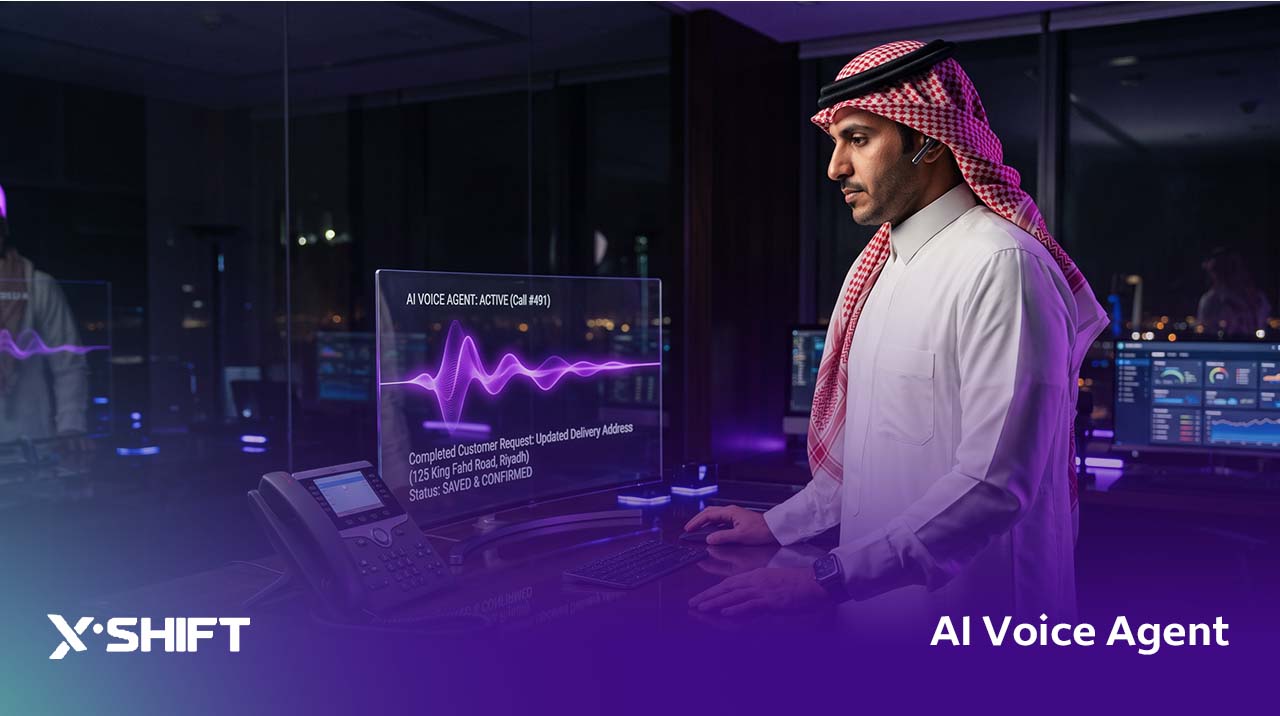
AI Voice Agent Solutions in Saudi Arabia: Arabic-First CX
Customers increasingly expect fast, natural, and always-available support without being forced through rigid phone menus or long waiting queues. An AI Voice Agent gives organizations a more intelligent way to manage voice interactions by combining conversational AI, speech recognition, natural language understanding, and workflow automation. X-Shift supports this evolution through Arabic-first conversational AI and voice bot capabilities designed to handle customer requests, maintain context, integrate with enterprise systems, and support seamless handoffs to human teams when needed.
What Is an AI Voice Agent?
An AI Voice Agent is a conversational system that can understand spoken language, respond naturally, and perform defined actions during a phone or voice interaction. Unlike traditional IVR systems that depend mainly on keypad selections and fixed menus, the technology can interpret customer intent, maintain conversational context, retrieve information, and interact with business systems. This makes voice automation more flexible and allows organizations to handle common customer journeys without requiring a human agent at every step.

Natural Voice Conversations
Modern voice automation is designed to make customer interactions feel more conversational. An AI Voice Agent can interpret spoken requests, identify the purpose of the call, and respond using natural language rather than forcing customers to follow a long sequence of menu options. This reduces customer effort and makes automated service easier to use, especially when the system can understand different ways of expressing the same request.
Context-Aware Interactions
Customer conversations often contain information that needs to be remembered from one step to the next. The system can preserve context during the interaction so customers do not have to repeat details that have already been provided. More advanced implementations can also use information from CRM and ticketing systems or previous interactions to deliver a more informed response while still applying appropriate privacy, access, and security controls.
Task Execution and Workflow Automation
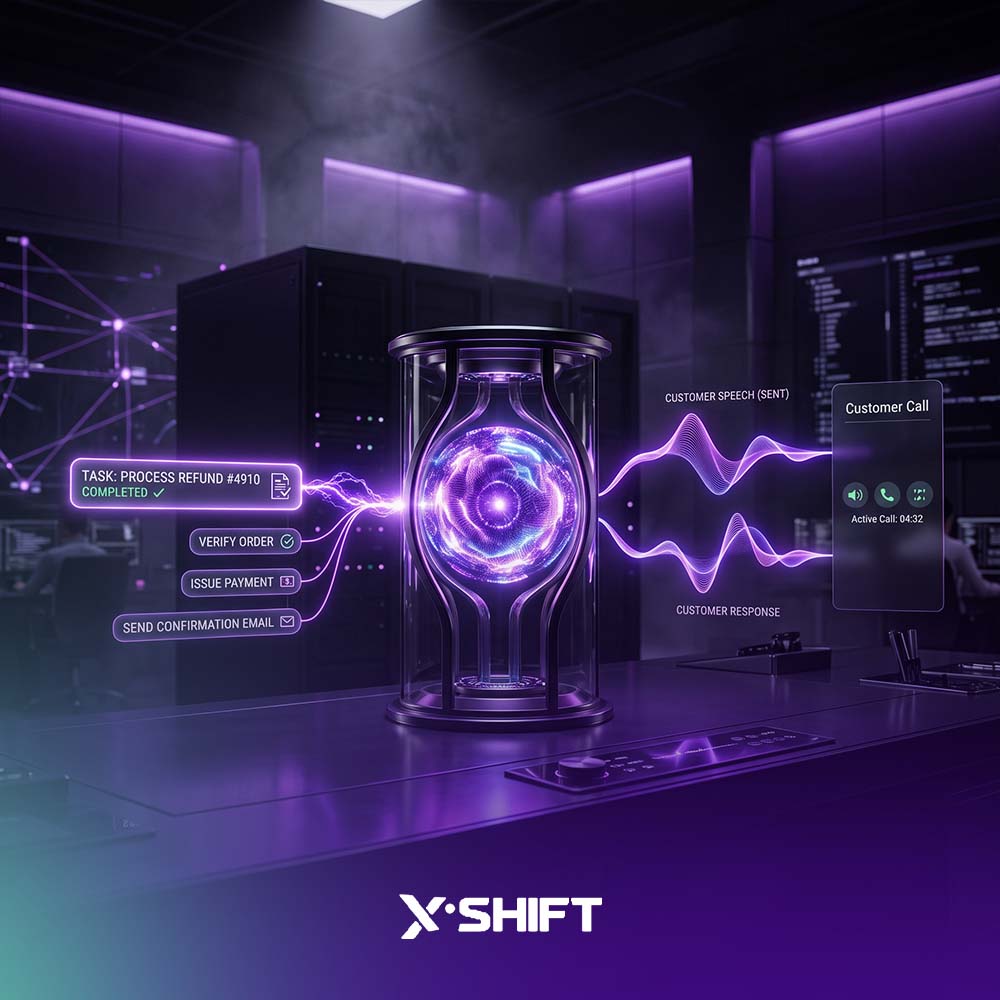
The value of voice automation increases when it can do more than answer questions. An AI Voice Agent can be connected to business workflows to perform actions such as checking an order, creating a service request, confirming an appointment, providing billing information, or updating a case. By linking conversation with execution, organizations can resolve more routine requests automatically through AI automation for business while reducing the amount of manual work required from service teams.
Why Are AI Voice Agents Important for Customer Service?
An AI Voice Agent can help organizations manage growing customer demand while maintaining consistent service availability. Omnichannel customer contact centres often face unpredictable call volumes, repetitive requests, and pressure to reduce waiting times without continuously increasing staffing. Intelligent voice automation can absorb suitable routine interactions, provide support outside normal operating hours, and allow human agents to focus on conversations that require judgment, empathy, negotiation, or specialized knowledge.
Reducing Customer Waiting Time
Long queues are one of the most visible sources of frustration in customer service. An AI Voice Agent can handle multiple conversations simultaneously, allowing common requests to be processed without waiting for an available human agent. This can be particularly valuable during peak periods, campaign activity, service disruptions, or seasonal increases in demand, when traditional staffing models may struggle to match the sudden rise in call volume. Implementing this is a key step to improve customer experience overall.
Providing 24/7 Availability
Customers may need support outside traditional working hours. Voice automation can provide continuous access to selected services such as account information, appointment management, order status, or frequently requested guidance. This does not mean every issue should be automated, but it allows organizations to make appropriate services available around the clock while clearly transferring complex or sensitive cases to human teams when required.
Improving Service Consistency
Automated voice interactions can follow approved information, workflows, and business rules consistently across large numbers of calls. The system can reduce variation in how routine requests are handled and ensure required steps are followed. This supports more predictable service quality, while supervisors and service designers can update conversation flows centrally when policies, products, or customer requirements change. Organizations can also use automated quality monitoring to maintain standard compliance.
What Can an AI Voice Agent Do?
The best use cases depend on the organization’s services, systems, customer needs, and risk requirements. An AI Voice Agent is particularly effective for repetitive, high-volume journeys that have clear information requirements and defined outcomes. Organizations can start with a limited set of use cases, measure performance and customer response, and then expand automation gradually as the platform and operating model mature within their overall digital transformation strategy.
Customer Support and Service Requests
Voice automation can help customers check service status, ask common questions, report an issue, or create a support request. When integrated with internal systems, AI customer service solutions can identify the customer, capture the request, and create or update a case. If human assistance becomes necessary, the interaction can be transferred with the conversation history and collected information so the customer does not have to start again.
Appointment and Reminder Journeys
An AI Voice Agent can support appointment booking, confirmation, rescheduling, and reminder calls for sectors such as healthcare, government services, banking, and other appointment-based operations. Automated outbound calls can remind customers of upcoming commitments and capture responses, while inbound voice interactions can help customers make changes without waiting for a service representative. This can reduce manual call workload and improve the efficiency of appointment management.
Billing, Payments, and Order Information
Organizations can use an AI Voice Agent to provide information such as account balances, bill details, payment due dates, order tracking, or renewal reminders when the necessary systems are integrated. The voice experience can authenticate the customer according to the required process, retrieve relevant information, and guide the conversation through approved steps. Higher-risk transactions should include appropriate controls and human escalation when necessary.

How Does an AI Voice Agent Work?
An AI Voice Agent combines several technologies and enterprise integrations to turn spoken language into an operational response. Speech recognition converts audio into text, language models and intent systems interpret what the customer wants, business logic determines the next step, and text-to-speech generates the response. Integrations with CRM, knowledge management systems, ticketing, and other platforms allow the conversation to access information and execute approved actions.
Speech Recognition and Language Understanding
High-quality speech recognition is essential because customers speak at different speeds, use different accents, and may switch between languages. The system must then interpret meaning and intent rather than simply identify individual words. For organizations serving Arabic-speaking customers, dialect awareness and the ability to handle mixed Arabic-English conversations can be especially important for creating interactions that feel natural and accurately reflect how customers communicate in real situations. For deeper insights on local market developments, read about CX trends in Saudi Arabia.
Knowledge and Enterprise Integration
An AI Voice Agent becomes more useful when it connects to trusted knowledge and operational systems. Integration can allow it to retrieve approved answers, check customer records, create tickets, access order information, or trigger business workflows. Open APIs and system connectors are therefore important considerations during implementation, because the value of the voice experience depends heavily on what the system can securely access and accomplish behind the conversation.
Human Handoff With Full Context
Not every conversation should remain automated. The system should recognize when a customer needs human support because of complexity, sentiment, policy, or a failed automation path. A well-designed handoff transfers the conversation history, identified intent, and relevant information to the human agent. This prevents customers from repeating everything and makes automation feel like part of one unified digital customer experience journey rather than a disconnected barrier before reaching support.
How Should Organizations Implement Voice AI?
Successful voice automation requires more than deploying a model and connecting a phone number. Organizations should evaluate their digital maturity assessment platform data, select appropriate use cases, design conversations around customer needs, connect reliable data and systems, establish security controls, and define when humans should take over. The solution should be tested with real language patterns and operational scenarios before broad deployment, with ongoing monitoring used to improve intent recognition, response quality, containment, and customer satisfaction.
Start With High-Volume, Clear Use Cases
The strongest starting points are usually journeys that occur frequently and follow defined rules. Examples include order status, appointment confirmation, basic service requests, or common billing questions. Starting with these interactions makes it easier to measure whether automation is reducing waiting time, improving completion rates, and decreasing agent workload. Organizations can then expand to more complex journeys after the technology and governance model prove reliable.
Design for Natural Conversation
Customers should not need to learn how to speak to the system. Conversation design should allow natural phrasing, clarify ambiguous requests, confirm important information, and avoid overly long responses. Testing should include accents, dialects, interruptions, background noise, and common language switching patterns. Good voice design also gives customers a clear way to request human assistance rather than trapping them inside an automated flow, taking inspiration from how to create an omnichannel strategy for a seamless customer journey.
Measure and Improve Performance
Organizations should monitor outcomes such as successful resolution, transfer rates, repeated calls, response accuracy, customer satisfaction, average conversation duration, and reasons for failed automation. Advanced call center analytics help teams identify where conversation design, integrations, or knowledge need improvement. Continuous optimization is important because customer language, services, and business processes change over time, and voice automation should evolve with them.
How X-Shift Supports AI Voice Agent Capabilities
X-Shift provides AI Voice Agent capabilities through its conversational AI portfolio, including AI-powered voice bots and X-Shift Agentic AI. The platform is designed to support natural interactions across voice, chat, and digital channels, with contextual conversations, multilingual capabilities, Arabic expertise, CRM and ticketing integration, open APIs, and enterprise deployment options. X-Shift also supports smooth handoffs to human agents with conversation context when automated service needs to escalate.
Arabic-First and Multilingual Conversational AI
X-Shift emphasizes Arabic-first conversational intelligence while supporting more than 100 languages and dialect-specific Arabic capabilities. This is important for organizations operating in Saudi Arabia and other Arabic-speaking markets, where customers may use local dialects or switch naturally between Arabic and English. Learn more about the future of contact centers in Saudi Arabia and how localized voice platforms can improve understanding and make automated interactions feel more appropriate.
Integration With CRM, Ticketing, and Digital Workflows
X-Shift connects its voice and conversational AI capabilities with CRM, ticketing platforms, internal systems, and automated workflows through integrations and open APIs. An AI Voice Agent can therefore move beyond answering FAQs and participate in operational journeys such as complaints, service requests, order tracking, billing inquiries, reminders, and other defined processes. Discover how AI for business growth can transform operational efficiency through these connections.
Agentic AI for Goal-Driven Voice Interactions
X-Shift Agentic AI extends traditional voice automation by supporting systems that can listen, reason, decide, and act across customer touchpoints. Rather than limiting the interaction to fixed responses, agentic capabilities can work with business rules, context, memory, and connected systems to pursue a defined service goal. Read about how X-Shift launches Agentic AI platform built for Saudi enterprises to see how this creates opportunities for more autonomous customer journeys.
For organizations seeking to reduce waiting times, automate high-volume customer journeys, improve Arabic voice experiences, and connect conversations with real business actions, X-Shift can help implement an AI Voice Agent that combines conversational intelligence, enterprise integration, and flexible human handoff within a broader customer experience strategy. You can explore our full range of managed services or contact us to get started.