
Managed Security Service Provider (MSSP) Solutions in KSA
Cyber threats continue to evolve as organizations rely more heavily on cloud platforms, connected systems, digital services, and distributed work environments. X-Shift helps organizations strengthen protection through Managed Security Services that combine proactive monitoring, cybersecurity expertise, resilient infrastructure practices, and operational support. This approach allows businesses to improve security visibility, reduce pressure on internal teams, and maintain stronger protection while focusing on core operations and long-term growth.
What Are managed security service provider MSSP?
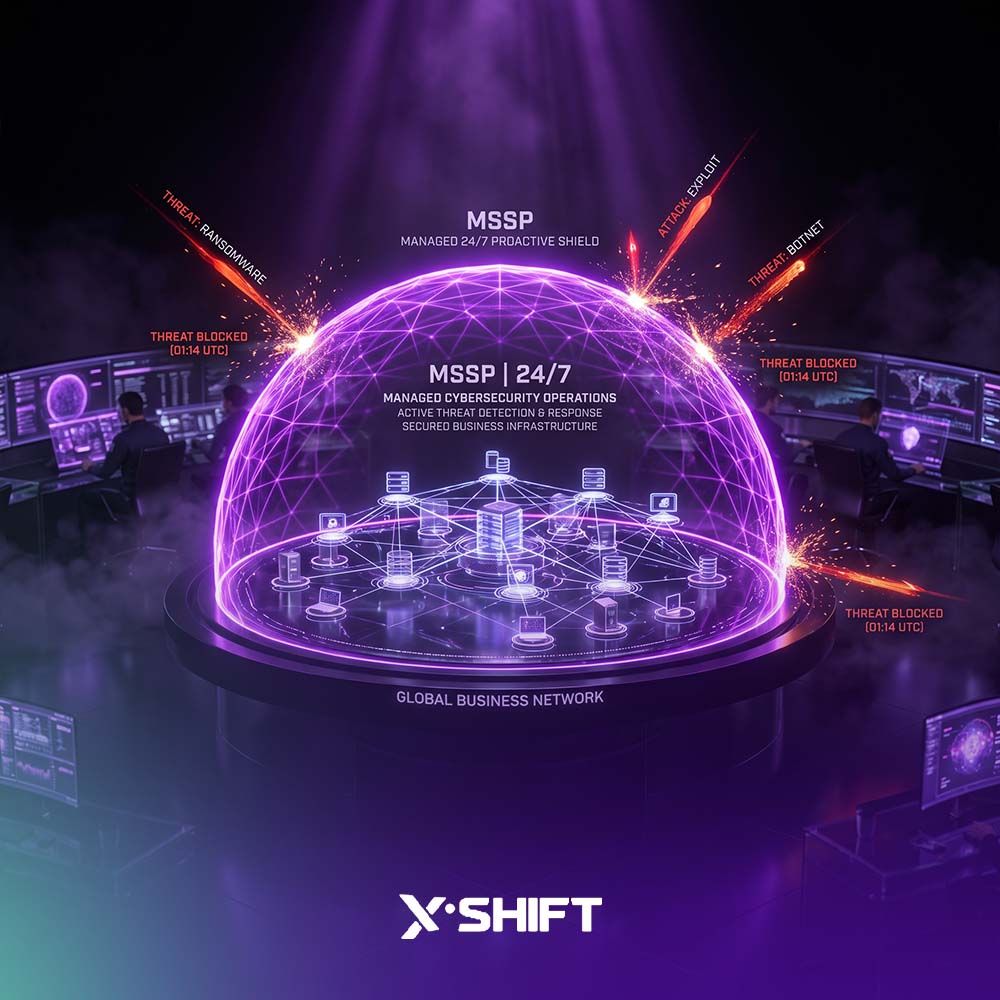
managed security service provider MSSP are outsourced cybersecurity capabilities delivered by a specialized provider to help organizations monitor, protect, and improve their security environment. Rather than relying only on internal resources, businesses can use external expertise, processes, and tools to support continuous monitoring, threat detection, vulnerability management, incident response, and security operations. The model is especially useful when security requirements grow faster than the organization’s ability to build and maintain specialized teams internally.

Continuous Security Monitoring
A managed security model can provide ongoing visibility into systems, networks, endpoints, and other critical technology environments through comprehensive network monitoring services. Continuous monitoring helps identify unusual behavior, suspicious activity, and potential security events before they develop into larger incidents. A structured monitoring process also reduces dependence on periodic manual reviews and gives security teams a clearer picture of what is happening across the environment, including events that may otherwise remain unnoticed for long periods.
Access to Specialized Cybersecurity Expertise
Cybersecurity requires knowledge across many disciplines, including network security, cloud protection, identity, incident response, vulnerability management, and threat analysis. This model gives organizations access to specialized skills without requiring every capability to be built internally through dedicated IT support services for businesses. This can help close talent gaps, support internal teams during complex incidents, and provide practical guidance on security priorities, controls, and improvements as threats, technologies, and business requirements continue to change.
Proactive Threat Detection
A reactive security model begins after damage has already occurred. A proactive managed approach is designed to improve early detection by combining monitoring, security tools, threat intelligence, and defined response processes. By leveraging smart business solutions, teams can investigate suspicious events more quickly, identify patterns that may indicate an attack, and take action before an issue expands. Faster detection can reduce the potential operational, financial, and reputational impact of a security incident.
Why Do Businesses Need managed security service provider MSSP?
Organizations face a growing combination of sophisticated threats, expanding attack surfaces, compliance requirements, and limited cybersecurity resources. A managed security model can help businesses address these pressures through a more structured operating model that supports continuous protection and consistent security practices. Instead of treating cybersecurity as a series of isolated projects, organizations can establish ongoing monitoring, maintenance, response, and improvement processes that evolve alongside their technology environment.
Addressing Cybersecurity Talent Gaps
Building a complete in-house security team can be difficult because experienced cybersecurity professionals are in high demand and different security functions require different expertise. Utilizing IT support for businesses as external security support can supplement internal capabilities with dedicated specialists and established operating processes. This allows internal technology teams to focus on strategic priorities while receiving support for monitoring, investigation, remediation, and other security activities that require focused expertise and continuous attention.
Protecting Expanding Digital Environments
Organizations increasingly operate across cloud services, remote endpoints, branch locations, mobile devices, applications, and third-party platforms. Each addition can create new security considerations and make visibility more difficult. Partnering with a managed provider helps organizations apply structured security practices across a broader attack surface, realizing the core IT outsourcing benefits. This is particularly important when business growth or a broader digital transformation strategy introduces new technologies faster than internal security operations can adapt.
Supporting Business Continuity
Cyber incidents can disrupt systems, delay services, and affect access to critical information. Managed cybersecurity supports business continuity by helping organizations detect threats earlier, respond through defined processes, and maintain stronger security controls around essential systems. When combined with backup, disaster recovery, and continuity planning—often executed as part of IT modernization services—managed cybersecurity becomes part of a wider resilience strategy designed to reduce downtime and support faster recovery when disruptive events occur.

What Capabilities Should managed security service provider MSSP Include?
The right security model depends on the organization’s size, industry, technology environment, regulatory obligations, and risk profile. Managed Security Services should therefore be evaluated according to the capabilities the business actually needs rather than a generic list of tools. A strong service should combine visibility, prevention, detection, response, and continuous improvement while integrating with existing systems and supporting clear communication between the provider and the organization’s internal teams.
Security Monitoring and Alert Management
Security tools can generate large volumes of alerts, and not every alert represents a genuine threat. A managed security provider can help review, prioritize, and investigate security events so teams can focus on activity that requires action. Effective alert management reduces noise and improves response speed by applying defined processes, contextual analysis, and escalation rules. Organizations can leverage insights from recent market reports to turn raw security events into meaningful decisions rather than overwhelm teams with disconnected notifications.
Vulnerability and Risk Management
Technology environments change constantly as systems are updated, applications are added, and new vulnerabilities are discovered. A managed security program can support ongoing vulnerability identification, prioritization, and remediation planning. Rather than treating every vulnerability equally, organizations can evaluate their standing using a digital readiness assessment to focus on issues according to severity, exposure, asset importance, and business impact. This risk-based approach helps security teams use resources more effectively and reduce weaknesses that are most likely to create significant problems.
Incident Response and Escalation
When a serious security event occurs, clear responsibilities and fast communication are essential. A managed security program can provide defined incident workflows that support investigation, containment, escalation, and recovery. The provider and internal teams should understand who is responsible for each action and when senior stakeholders need to be involved. Well-prepared response processes reduce confusion during high-pressure situations and help organizations move from detection to containment more efficiently.
How Do Managed Security Services Improve Security Operations?
Managed Security Services can improve security operations by making monitoring and response more systematic, measurable, and repeatable. Instead of depending on individual effort or occasional reviews, the organization gains structured processes that operate continuously. This can improve visibility across technology assets, establish clearer escalation procedures, and create better information for security decisions. The result is a security function that can respond more consistently as threats and business requirements evolve.
Faster Detection and Response
The time between an attacker entering an environment and the organization identifying the activity can have a major effect on the impact of an incident. Managed Security Services can shorten this window through continuous monitoring and established investigation processes. Furthermore, deploying advanced AI automation for business allows analysts to review context, determine severity, and escalate suspicious events quickly. Faster action can help contain threats before they spread across systems or affect critical business services.
More Consistent Security Processes
Security effectiveness can suffer when monitoring, patching, escalation, and response depend on informal practices. A managed model introduces documented procedures, service responsibilities, and regular operational routines. Implementing structured five strategies for optimizing business processes through digital transformation makes security activities easier to track and improve over time. It also helps organizations reduce gaps that may appear when key employees are unavailable or when responsibilities are unclear between infrastructure, security, application, and business teams.
Better Security Visibility
Organizations need to know where security risks exist before they can manage them effectively. managed security service provider MSSP can improve visibility by bringing together information from monitoring tools, infrastructure, endpoints, and other relevant sources. This creates a clearer view of events and patterns across the environment. Better visibility also supports reporting, risk discussions, and prioritization by helping leadership evaluate the future of digital transformation and understand where attention and investment may be required.
How Should Organizations Choose a Managed Security Provider?
Selecting a provider requires more than comparing tools or service prices. Managed Security Services should align with the organization’s risk profile, technology environment, operating model, and business priorities. The provider should be able to explain how monitoring works, how incidents are escalated, what responsibilities remain with the customer, and how service performance will be measured. Clear expectations are essential for building a reliable security partnership.
Evaluate Coverage and Expertise
Organizations should confirm that the provider can support the technologies and security areas most relevant to their environment. This may include infrastructure, cloud, endpoints, networks, applications, and identity controls. Enterprise needs may also require specialized domain alignment, such as government digital transformation. The quality of Managed Security Services depends heavily on the expertise behind the tools, so businesses should evaluate the provider’s ability to analyze events, communicate risks clearly, and support practical remediation rather than only generate technical alerts.
Review Response and Communication Processes
Cybersecurity incidents require fast coordination, so organizations should understand how the provider communicates during different levels of severity. Managed Security Services should include clear escalation paths, contact procedures, response expectations, and reporting methods. Businesses should also define how internal teams and the provider will share information and make decisions. Strong communication can be just as important as technology when the organization needs to respond to a rapidly developing security event.
Consider Scalability and Integration
Security requirements can change as the organization grows, adopts cloud services, adds locations, or introduces new applications. Managed Security Services should be flexible enough to support this evolution without forcing the business to redesign its entire security model. Evaluating the enterprise’s current state on a digital maturity assessment platform ensures seamless integration with existing tools and infrastructure. A scalable, connected service can provide more value over the long term.
How X-Shift Supports managed security service provider MSSP
X-Shift provides Managed Security Services within its broader managed IT services portfolio, helping organizations strengthen protection while improving the reliability and efficiency of technology operations. Its managed services offering includes cybersecurity, infrastructure services, communications, disaster recovery, data analytics, and customer support. X-Shift emphasizes proactive threat monitoring, advanced security strategies, scalable solutions, and continuous operational support, allowing organizations to approach security as part of a wider resilience and managed services strategy.
Proactive Cybersecurity Monitoring
X-Shift supports businesses with cybersecurity capabilities focused on proactive monitoring and protection against evolving digital risks. By leveraging advanced solutions like Agentic AI and incorporating managed security service provider MSSP into a broader operational model, organizations can improve security oversight while reducing the burden of maintaining every monitoring and support capability internally. This approach is particularly valuable for businesses seeking ongoing protection that can adapt as infrastructure, applications, and threat conditions change.
Security Integrated With Managed IT Operations
Cybersecurity is closely connected to infrastructure reliability, communications, data protection, and continuity. X-Shift combines Managed Security Services with other managed capabilities, including infrastructure management and disaster recovery, creating opportunities for a more coordinated operational approach. This helps organizations avoid treating security as an isolated function and supports stronger alignment between technology performance, cyber resilience, system availability, and business continuity requirements.
Scalable Support for Business Growth
As businesses expand, security complexity often increases alongside the number of users, systems, locations, and digital services. X-Shift provides managed solutions designed to scale with changing operational needs. Organizations looking to explore these operational models or collaborate can visit the become a partner page or read more on our latest company news. This allows organizations to strengthen security capabilities without creating unnecessary internal complexity, while maintaining access to technical expertise, proactive support, and managed services that can evolve as the business environment and risk landscape change.
For organizations looking to improve cyber resilience, strengthen monitoring, reduce pressure on internal teams, and build more consistent security operations, X-Shift can provide managed security service provider MSSP that connect cybersecurity expertise with infrastructure, disaster recovery, and broader managed IT capabilities. If you are ready to secure your operations, please contact our team today.