
AI Knowledge Management Solutions for Enterprises
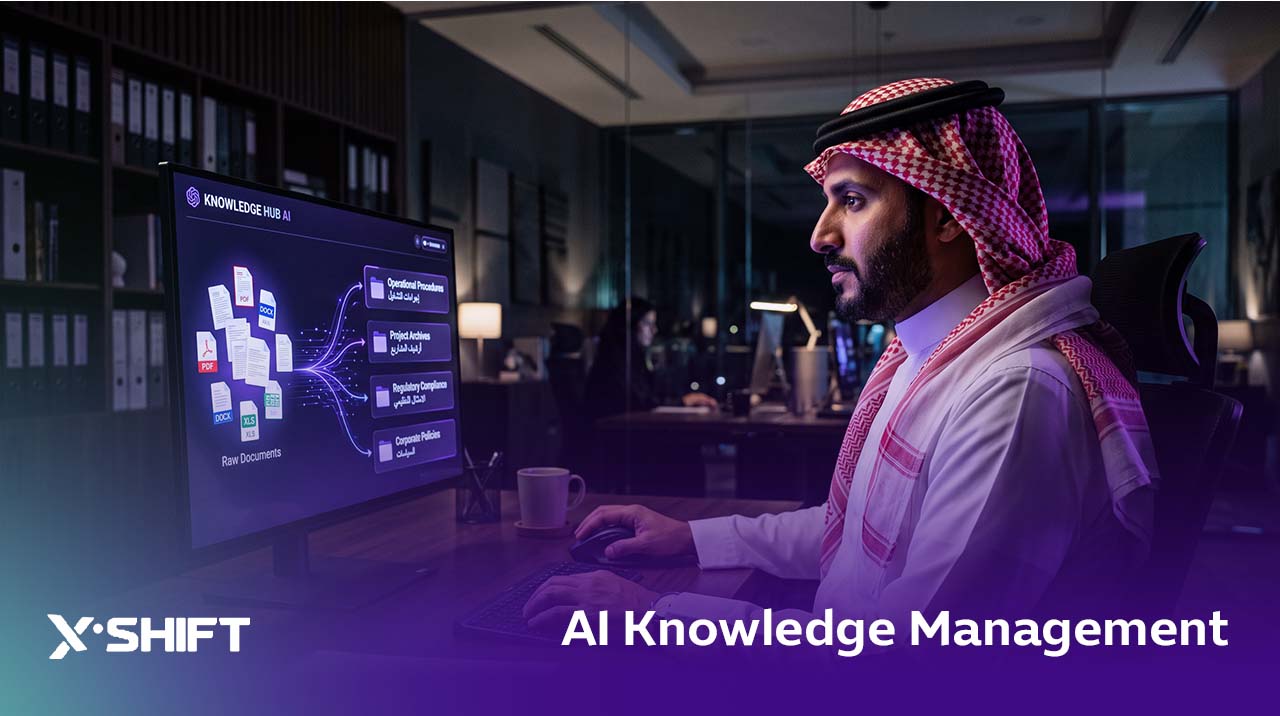
Organizations generate knowledge every day through documents, service tickets, policies, procedures, customer conversations, reports, and employee expertise. The challenge is no longer creating information, but making the right information easy to find, trust, and use. X-Shift helps organizations address this challenge through AI Knowledge Management capabilities that bring enterprise knowledge into a more structured, searchable, and intelligent environment, supporting faster decisions, more consistent service, and better access to critical information.
What Is Ai Knowledge Management?
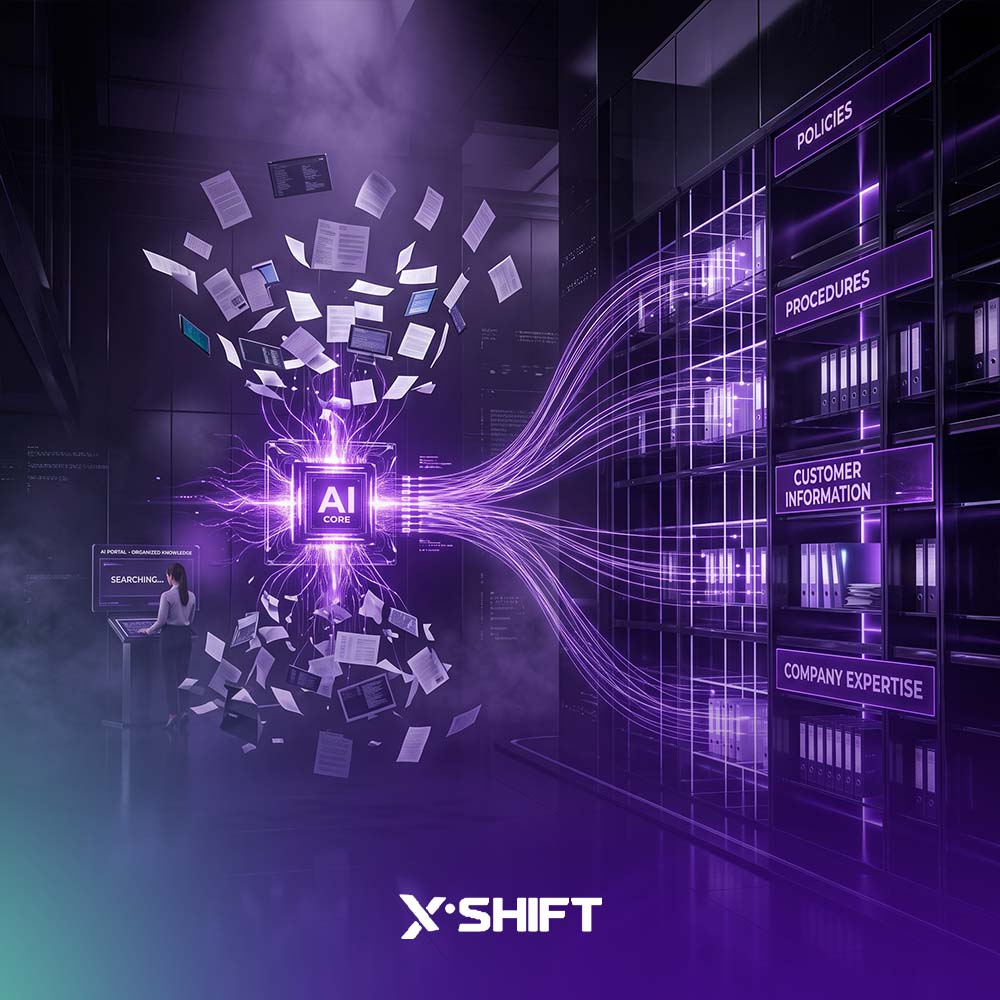
AI Knowledge Management combines knowledge management practices with artificial intelligence to help organizations capture, organize, retrieve, and improve information more efficiently. Instead of relying only on folders, manual search, or static knowledge bases, the approach uses technologies such as natural language processing, semantic search, generative AI, and intelligent recommendations to connect users with relevant knowledge when they need it.

Centralizing Enterprise Knowledge
AI Knowledge Management helps organizations bring policies, procedures, FAQs, manuals, service information, and other knowledge assets into a more unified environment. Centralization reduces the time employees spend searching across disconnected systems and makes it easier to maintain consistent information. It also gives organizations a clearer view of what knowledge already exists, where duplication appears, and which important topics still require structured documentation or updates.
Making Search More Intelligent
Traditional keyword search often depends on users knowing the exact words contained in a document. AI Knowledge Management improves this experience by interpreting intent, context, and meaning, allowing users to ask more natural questions and receive more relevant results. Intelligent search can reduce the number of steps required to find an answer, support employees during customer interactions, and make large knowledge repositories easier to use without requiring users to understand their internal folder structures.
Why Does Intelligent Knowledge Matter?
As organizations grow, knowledge becomes distributed across departments, applications, documents, emails, and individual employees. AI Knowledge Management provides a way to reduce this fragmentation and turn organizational information into a more accessible operational resource. When employees can find reliable answers faster, organizations can improve productivity, reduce repeated work, support service consistency, and preserve valuable knowledge that might otherwise remain dependent on specific individuals.
Improving Employee Productivity
AI Knowledge Management can reduce the time employees spend searching for procedures, checking multiple systems, or asking colleagues for information that already exists. Instead of navigating through long document libraries, users can access relevant answers and supporting content more quickly. This allows teams to spend more time on decision-making, customer service, problem-solving, and other higher-value activities while reducing delays caused by fragmented or difficult-to-find information. Check out our insights on ai for business growth to learn more.
Supporting Consistent Customer Service
AI Knowledge Management can help customer-facing teams use the same approved information across contact centers, digital channels, and support operations. When agents have quick access to updated procedures, product information, troubleshooting steps, and policies, they are less likely to provide conflicting answers. This consistency can improve customer experience, shorten handling time, and make it easier for new employees to perform effectively without depending entirely on informal knowledge from experienced colleagues.
Preserving Institutional Knowledge
Employees often hold valuable expertise that may not be fully documented. When experienced staff change roles or leave the organization, this knowledge can be difficult to replace. AI Knowledge Management supports a more systematic approach to capturing, organizing, and reusing institutional knowledge so that important information remains available to teams. Over time, this creates a stronger organizational memory and reduces the operational risk of relying too heavily on a small number of subject matter experts.
How Does AI Transform Knowledge Management?
The value of AI Knowledge Management comes from its ability to improve several stages of the knowledge lifecycle, from discovery and retrieval to creation, maintenance, and analysis. AI can help organizations understand what users are searching for, identify gaps in existing content, surface relevant information in context, and support content teams in keeping knowledge more current. Human governance remains important to ensure that information stays accurate, approved, secure, and appropriate for use.
Semantic Search and Natural Language Queries
AI Knowledge Management can use semantic search to understand the meaning behind a question rather than matching only individual keywords. An employee might describe a problem in everyday language while the official procedure uses different terminology, yet the system can still identify relevant content. This improves knowledge discovery, reduces failed searches, and creates a more intuitive experience for users who may not know the exact document title, category, or terminology used inside the organization.
Generative AI for Faster Answers
AI Knowledge Management can use generative AI to summarize information and present answers based on approved enterprise knowledge. Instead of requiring a user to open several long documents, the system can help surface concise, contextual information while directing users back to the relevant source material. This can be especially useful in support environments where employees need quick guidance, although organizations should maintain clear controls around source quality, permissions, review processes, and content ownership. Learn how to deploy the role of ai chatbots and virtual assistants in enhancing customer support.
Continuous Knowledge Improvement
AI Knowledge Management can also help organizations understand how knowledge is being used. Search behavior, repeated questions, unsuccessful queries, and content usage patterns can reveal where information is missing or difficult to understand. Knowledge teams can use these insights to improve articles, update procedures, remove duplication, and prioritize new content. This creates a continuous improvement cycle in which the knowledge base evolves according to real employee and customer needs rather than relying only on periodic manual reviews.

How Should Organizations Implement Intelligent Knowledge Systems?
Successful AI Knowledge Management requires more than deploying an AI search tool. Organizations need to establish reliable content, clear ownership, permissions, integration, and governance before expecting strong results. A phased implementation can begin with high-value knowledge domains, measure usage and search performance, and then expand gradually. This reduces implementation risk and helps teams learn how employees actually interact with knowledge before extending the platform across the entire organization. Exploring digital transformation strategies is often key to this foundation.
Organize and Prepare Knowledge Sources
AI Knowledge Management works best when the underlying knowledge is accurate, structured, and maintained. Organizations should identify authoritative sources, remove outdated or duplicated content, define content categories, and establish ownership for key knowledge areas. This preparation makes retrieval more reliable and reduces the risk that users receive conflicting information. It also gives teams a stronger foundation for future automation, self-service, and AI-assisted support across multiple business functions. You can evaluate your readiness using our digital readiness assessment tool.
Establish Governance, Security, and Access
AI Knowledge Management must respect the same security and access requirements that apply to enterprise information. Not every employee should see every document, and sensitive material should remain protected according to organizational policies. Clear permissions, content ownership, review cycles, and approval workflows help maintain trust in the platform. Governance also ensures that generated or recommended answers are based on appropriate sources and that users can verify important information when necessary.
Integrate Knowledge Into Daily Workflows
The effectiveness of a knowledge platform depends on whether employees can access it where work actually happens. AI Knowledge Management should integrate with systems such as crm and ticketing systems, service desks, omnichannel customer contact centre platforms, collaboration tools, and other business applications whenever appropriate. Bringing knowledge into the flow of work reduces context switching and allows employees to use relevant guidance while handling a customer request, completing a process, or making an operational decision.
How X-Shift Supports Intelligent Knowledge Operations
X-Shift supports AI Knowledge Management through an enterprise knowledge management approach designed to make organizational information easier to access, maintain, and apply. Its knowledge management offering includes centralized knowledge bases, decision trees, visual guides, AI-powered insights, content management, CRM integration, API-based flexibility, ai automation for business processes, and enterprise-focused deployment options. This gives organizations a foundation for improving both employee productivity and the consistency of customer-facing service.
Intelligent Knowledge Access and Content Management
X-Shift helps organizations structure knowledge in a central environment that can include FAQs, institutional documents, procedures, visual guidance, and decision trees. Its platform also uses AI-driven insights to analyze usage patterns and support continuous improvement of the knowledge base. By combining access, content management, and guided decision support, AI Knowledge Management can become a practical part of daily operations instead of functioning as a static document repository that employees use only occasionally. View our comprehensive cx solutions for more capabilities.
Integration, Scalability, and Enterprise Readiness
X-Shift supports integration with CRM environments and external platforms through APIs, while also offering automated workflows and deployment options designed for enterprise requirements, such as our managed services. This helps organizations connect knowledge with customer service and operational processes rather than keeping it isolated in a separate tool. The platform also emphasizes security, scalability, and ongoing support, which are important considerations when knowledge is used across multiple teams, locations, and service channels.
For organizations looking to reduce information silos, improve employee access to trusted content, and deliver more consistent support, X-Shift can help build AI Knowledge Management as a connected capability that brings together enterprise knowledge, intelligent access, workflow integration, and continuous improvement. Feel free to contact us or visit our blogs section for the latest updates.