
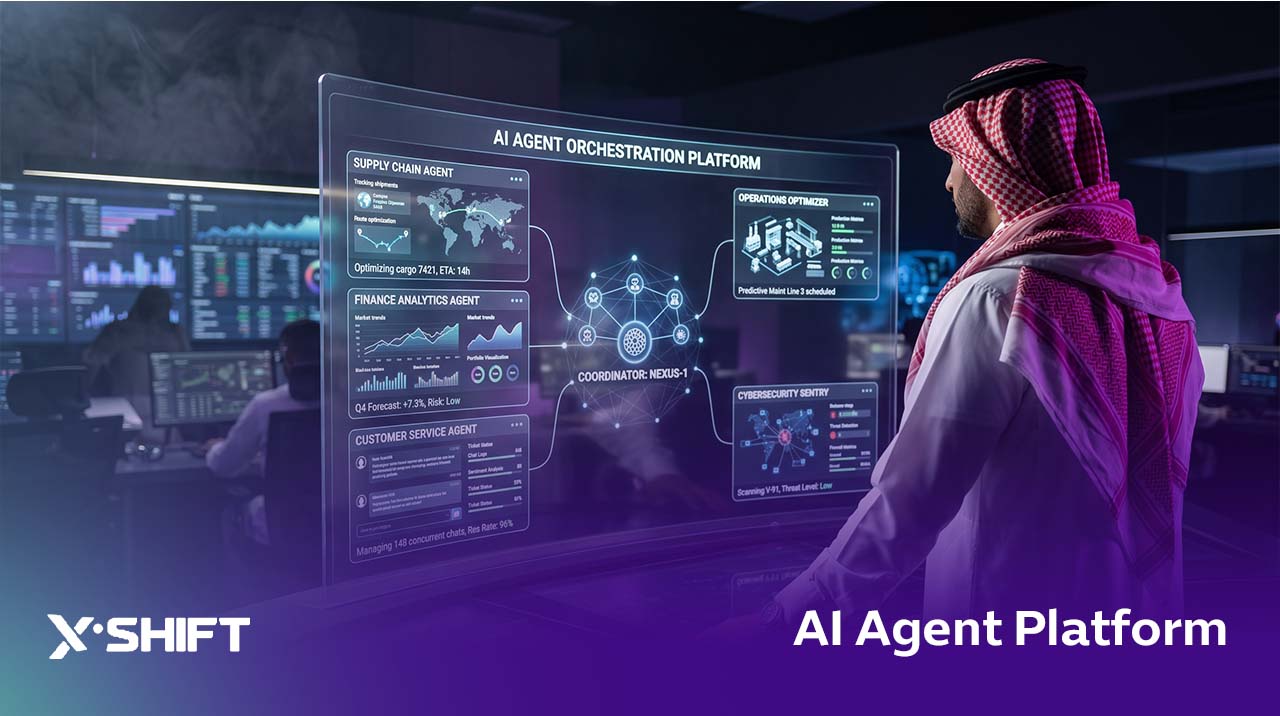
AI Agent Platform: Empowering Enterprise Automation in Saudi
Organizations are moving beyond basic chatbots toward systems that can understand goals, reason across context, and take action inside business workflows. An AI Agent Platform gives enterprises a foundation for building intelligent agents that can communicate with customers, access approved information, connect with operational systems, and complete defined tasks. X-Shift supports this shift through its Arabic-first Agentic AI capabilities, designed for voice, chat, and digital channels while integrating with existing customer experience environments.
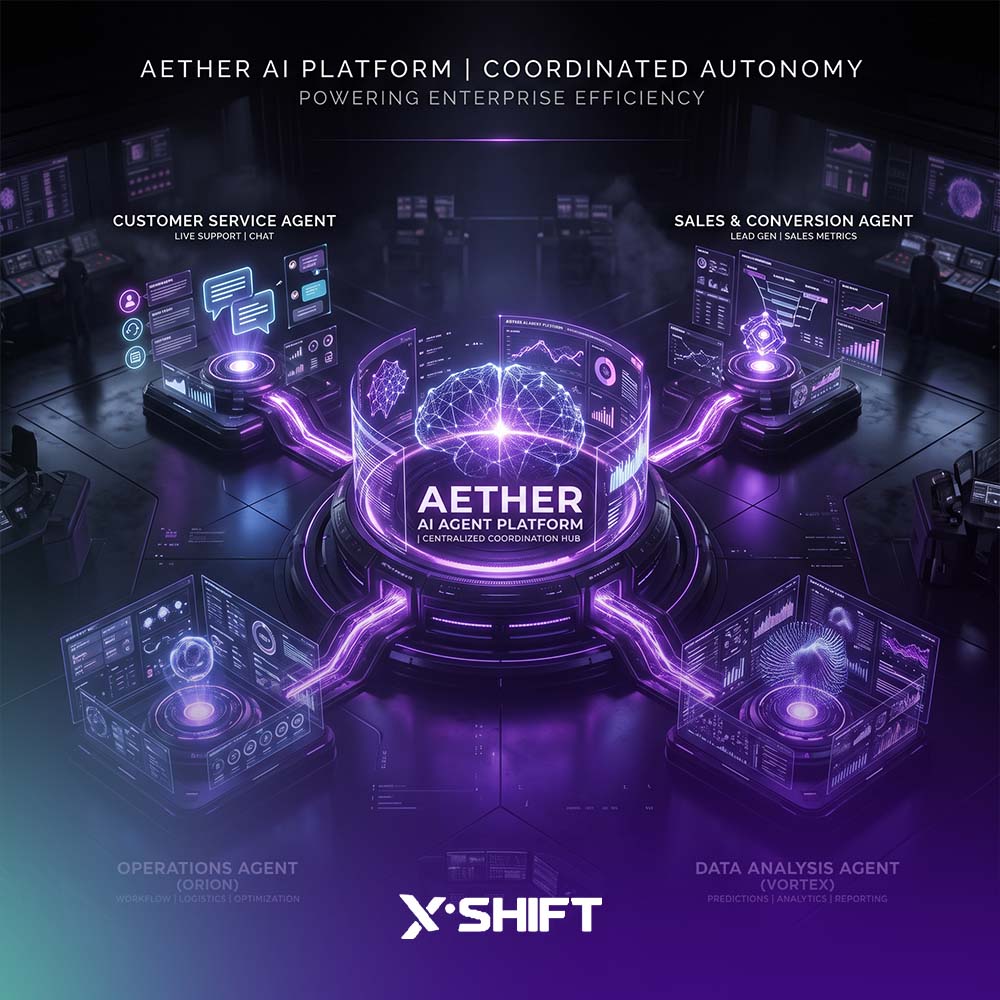
What Is an AI Agent Platform?
An AI Agent Platform is an enterprise technology environment that enables intelligent agents to interpret requests, reason about the next step, and execute actions through connected systems. Unlike traditional conversational tools that mainly provide answers, agentic systems are designed to work toward a defined outcome. They can use context, business rules, memory, knowledge, and integrations to move a customer journey forward rather than ending the interaction with information alone.

From Conversation to Action
An AI Agent Platform extends conversational AI by connecting language understanding with operational execution. A customer may ask to reschedule an appointment, check an order, submit a complaint, or update a service request, and the agent can use authorized integrations to complete the relevant steps. This reduces the gap between asking for help and receiving an outcome, making automation more useful for real customer journeys.
Goal-Driven Reasoning
A strong AI Agent Platform does not simply match a request to a fixed response. It can evaluate context, identify the objective, follow business rules, and determine which approved action should happen next. This makes the interaction more flexible than rigid decision trees while still allowing the organization to define controls, permissions, escalation rules, and boundaries for what the agent is allowed to do.
Enterprise System Integration
The value of the platform depends heavily on its ability to connect with CRM and ticketing systems, knowledge bases, omnichannel contact centers, scheduling tools, and other enterprise applications. Integration allows the agent to retrieve relevant information and trigger actions without forcing customers or employees to switch between multiple channels. It also helps preserve context across the complete service journey.
Why Are AI Agent Platforms Important for Enterprises?
An AI Agent Platform can help organizations manage high interaction volumes while improving speed, consistency, and operational efficiency. Customer service teams often spend significant time on repetitive journeys that follow clear business rules. Agentic automation can handle suitable tasks end to end, allowing human employees to focus on situations that require empathy, negotiation, specialized expertise, or exception handling.
Faster Customer Resolution
An AI Agent Platform can reduce the number of handoffs required to complete common service requests. Instead of answering a question and directing the customer somewhere else, the agent can perform the approved next step when the required integrations are available. This can shorten resolution time, reduce repeated contact, and improve overall customer experience for those who expect immediate support across digital and voice channels.
24/7 Service Availability
The platform can provide continuous access to selected services without depending entirely on human staffing schedules. Customers may be able to track orders, manage appointments, receive billing information, create support requests, or complete other defined journeys at any time. Human escalation remains important for complex or sensitive cases, but routine services can remain available outside traditional operating hours.
More Consistent Execution
The platform can follow defined business rules and workflows consistently across large volumes of interactions. This can reduce variation in how repetitive tasks are handled and help organizations maintain standardized processes through managed IT services. When policies or workflows change, the underlying rules and knowledge can be updated centrally, making it easier to keep automated journeys aligned with current operational requirements.
What Can an AI Agent Platform Do?
The most valuable use cases are usually those where the agent can combine conversation with a real business action. An AI Agent Platform can support inbound and outbound journeys, customer service, reminders, ticket creation, order tracking, appointment management, and campaign interactions. Organizations should prioritize use cases with clear goals, reliable data, measurable outcomes, and well-defined escalation paths.
Customer Service and Complaint Handling
An AI Agent Platform can capture a customer complaint, understand the issue, collect the required details, create a ticket, and provide a reference or next step. If the case requires human review, the interaction can be escalated with the conversation history and captured information. This reduces repeated questions and helps human agents begin with a clearer understanding of the issue, supported by automated quality monitoring tools.
Appointment and Notification Journeys
The platform can support appointment reminders, confirmations, rescheduling, renewal notices, and other proactive customer communications. Outbound agents can contact customers based on approved triggers, while inbound agents can respond when customers need to make changes. This creates a more automated service loop and reduces the manual workload associated with repetitive reminder and follow-up activities.
Order, Billing, and Service Requests
An AI Agent Platform can connect to business systems to provide order status, billing details, payment reminders, or service request updates when appropriate permissions and integrations are in place. The agent can also gather information and initiate workflows rather than only presenting static answers. This makes the platform useful for operational journeys where customers expect both information and action, expanding digital customer experience capabilities.

How Does an AI Agent Platform Work?
An AI Agent Platform typically combines natural language understanding, memory, knowledge, reasoning, business rules, integrations, and orchestration. The agent listens to the request, identifies the goal, evaluates available context, decides on an approved next step, and executes the action through connected systems. The workflow may also include verification, human approval, security controls, and feedback loops depending on the risk and complexity of the task.
Listen and Understand
The first stage is understanding what the user is trying to achieve. The platform may receive input through voice and chat bots, messaging applications, or other digital channels. Language models and conversational technologies interpret the request, while context from the current interaction or previous history can help distinguish between similar intents and reduce unnecessary clarification.
Reason and Decide
The agent then evaluates the goal, relevant context, available knowledge, business rules, and permitted actions. This reasoning layer is what separates more advanced agentic systems from simple response bots. The organization still needs governance that defines what the agent may decide independently, which actions require validation, and when the interaction must be transferred to a human employee.
Act and Learn
After choosing an approved next step, the agent can execute the task through enterprise integrations, such as creating a ticket or updating an appointment. Results from the action can then be used to continue the conversation and confirm the outcome. Performance data and feedback can also support ongoing optimization of prompts, workflows, knowledge, and escalation rules by leveraging call center analytics.
What Should Enterprises Look for in an AI Agent Platform?
Choosing an AI Agent Platform requires more than comparing language model capabilities. Enterprises should evaluate integration, security, governance, multilingual support, observability, scalability, human handoff, and the ability to control agent behavior. The platform should fit into the organization’s existing technology environment and support measurable business outcomes rather than creating another isolated AI tool.
Security and Governance
Enterprise agents may access customer records, operational data, or systems that can perform real actions. Strong governance is therefore essential. Organizations should define authentication, permissions, data access, action limits, logging, auditability, and approval requirements. Higher-risk tasks may need additional verification or human authorization before execution, helping balance automation with appropriate operational control.
Omnichannel and Multilingual Support
Customers may interact through WhatsApp, web chat, voice, social messaging, and mobile applications, sometimes switching languages within the same conversation. The platform should support the channels and languages relevant to the organization’s audience. For Saudi enterprises, Arabic and Saudi dialect understanding can be particularly important for delivering natural interactions that reflect how customers actually communicate. Learn more in our analysis on CX trends in Saudi Arabia.
Integration and Scalability
The platform should integrate with CRM, contact center, ticketing, knowledge, and other operational systems through reliable APIs or connectors. It should also support increasing volumes, additional use cases, and new channels without requiring the organization to rebuild the entire solution. Scalable architecture makes it easier to start with focused journeys and expand agentic automation as confidence and maturity increase, supported by a digital readiness assessment.
How X-Shift Supports AI Agent Platform Capabilities
X-Shift delivers AI Agent Platform capabilities through Agentic AI solutions in Saudi Arabia, an enterprise solution built to listen, reason, decide, and act across voice, chat, and digital channels. The platform is designed to support autonomous, goal-driven customer journeys while connecting with existing customer experience technologies and enterprise workflows. This allows organizations to move beyond question-answer automation toward systems that can complete defined business tasks.
Arabic-First Agentic AI
X-Shift has designed its agentic technology around Arabic customer interactions and Saudi market requirements. The platform supports natural conversations across voice, chat, and digital channels while maintaining conversational and operational context. This localization is important for enterprises that need automation to understand how customers communicate in real service environments rather than relying only on generic language behavior.
Autonomous Customer Journeys
X-Shift Agentic AI can support use cases such as complaints, order tracking, bill inquiries, payment reminders, appointments, campaigns, and renewal notices. The agent can reason using context, memory, business rules, and goals, then execute approved tasks across connected systems. This supports a shift from simple conversational assistance toward more complete automation of repetitive customer journeys.
Integration With the CX Technology Stack
X-Shift positions its agentic solution as an integration layer across customer experience environments, including CRM, contact center platforms, ticketing systems, knowledge management bases, and Voice of Customer tools. It also supports multiple digital engagement channels, including web chat and messaging platforms. This helps enterprises introduce agentic capabilities without treating them as a separate customer service environment.
For organizations seeking to automate customer journeys, reduce repetitive workload, and create more intelligent interactions across voice and digital channels, X-Shift can help implement an AI Agent Platform that combines Arabic-first conversational intelligence, enterprise integration, and goal-driven execution within a governed customer experience strategy through our digital transformation strategy.