
Integrated Digital Transformation Solutions: Strategy, Process & Growth
Organizations are under growing pressure to improve efficiency, respond faster to customers, use data more effectively, and adapt to continuous technological change. X-Shift helps enterprises address these priorities through digital transformation solutions that connect strategy, enterprise architecture, data governance, process improvement, digital applications, and maturity assessment. Instead of treating modernization as a series of isolated technology projects, this approach helps organizations build a coordinated roadmap that supports measurable business outcomes and long-term digital growth.
What Are Digital Transformation Services?
Digital transformation services are structured capabilities that help organizations redesign processes, modernize systems, improve data management, and build more connected digital operations. They may include maturity assessment, enterprise architecture, workflow automation, application development, integration, governance, analytics, and change enablement. The purpose is not simply to introduce new tools, but to create an operating model in which technology, data, people, and processes work together more effectively.Studying successful digital transformation examples in Saudi Arabia shows that their purpose is not simply to replace manual activities with software, but to create a connected operating model where technology supports strategic goals and better decisions.

Strategy and Digital Maturity Assessment
A strong transformation program begins with an accurate understanding of the current state. Digital transformation services can evaluate existing processes, systems, data practices, governance, and organizational capabilities to identify gaps and priorities. This assessment helps leadership define realistic targets, establish a baseline, and build a roadmap that reflects actual business needs rather than technology trends. It also creates a clearer basis for measuring progress over time.Reviewing Saudi CX & Digital Transformation Market Trends 2026 can help leadership align their operational goals with regional market expectations.
Enterprise Architecture and Technology Alignment
Enterprise architecture provides a structured view of how business capabilities, applications, information, and technology relate to one another. Digital transformation services use this view to reduce duplication, improve interoperability, and guide investment decisions. Instead of adding disconnected platforms, organizations can define a target architecture that supports scalability, integration, and long-term strategic goals. This makes technology planning more disciplined and reduces the risk of creating new digital silos.Reviewing Saudi CX & Digital Transformation Market Trends 2026 can help leadership align their operational goals with regional market expectations.
Process Optimization and Automation
Many organizations digitize existing procedures without first asking whether those procedures are efficient. Digital transformation services can help analyze workflows, remove unnecessary steps, clarify responsibilities, and identify opportunities for automation. Once the process is simplified, technologies such as workflow engines, robotic automation, and intelligent routing can reduce manual effort, shorten cycle times, and improve consistency while allowing employees to focus on work that requires judgment and expertise.Addressing common mistakes that ruin customer experience and how to avoid them during process redesign prevents companies from digitizing inefficient procedures.
Why Do Organizations Need Digital Transformation Services?
As organizations grow, they often accumulate systems, manual workarounds, duplicate data, and disconnected processes. Over time, this complexity can slow service delivery, increase costs, and make change more difficult. Digital transformation services provide a coordinated way to address these challenges by connecting modernization efforts to business priorities. They help organizations improve current performance while building the capabilities required for future growth, innovation, and resilience.
Improving Operational Efficiency
Modern transformation programs can reduce repetitive work, eliminate unnecessary handoffs, and improve the movement of information between departments. By integrating systems and automating routine activities, organizations can complete tasks faster and reduce errors. The result is not only lower administrative effort, but also better use of employee time. Teams can focus on analysis, customer engagement, problem-solving, and other activities that contribute more directly to organizational performance.Applying 10 ways to boost customer satisfaction for companies alongside process optimization allows employees to spend more time on analysis, innovation, customer engagement, and high-value strategic execution.
Enhancing Customer and Employee Experience
A modern digital environment should make interactions easier for both customers and employees. Integrated digital platforms reduce repeated data entry, simplify access to information, and create more consistent journeys across channels. When front-end experiences are connected to reliable back-end systems, customers receive faster service and employees gain the context they need to respond effectively. This reduces friction and supports a more professional and predictable experience. Addressing common mistakes that ruin customer experience and how to avoid them during process redesign prevents companies from digitizing inefficient procedures.
Building Greater Business Agility
Organizations need to respond quickly to market shifts, regulatory changes, customer expectations, and emerging technologies. Digital transformation services help build adaptable processes, scalable platforms, and better-integrated data so changes can be implemented with less disruption. A flexible digital foundation makes it easier to add services, modify workflows, introduce new channels, and support growth without rebuilding the entire technology environment each time requirements evolve.
What Are the Core Areas of Digital Transformation?
Successful transformation requires more than one technology or platform. It typically includes a combination of governance, architecture, data, applications, integration, process redesign, and measurement. Digital transformation services bring these capabilities together so improvements are coordinated rather than implemented in isolation. This approach helps organizations avoid duplicated investments and ensures that each initiative contributes to a wider transformation roadmap.
Data Governance and Data Quality
Reliable data is essential for analytics, automation, reporting, and artificial intelligence. A structured transformation approach can help organizations establish data ownership, quality standards, classification rules, access controls, and lifecycle policies. Strong governance reduces inconsistency and creates greater confidence in management information. It also provides the foundation needed to use data more effectively across departments while maintaining appropriate security, privacy, and compliance controls.
Digital Applications and Integration
Digital applications can improve customer journeys and internal operations when they are designed around real business requirements. A coordinated transformation approach supports the development and integration of applications so information can move between systems without unnecessary manual intervention. This reduces duplicated work and gives users a more connected experience. Integration also allows organizations to extend the value of existing systems rather than replacing every platform as part of modernization.
Measurement and Continuous Improvement
Transformation should be measurable from the beginning. Organizations need clear indicators related to service time, automation, digital adoption, data quality, productivity, customer satisfaction, or other objectives. By establishing a baseline and tracking results, teams can identify whether initiatives are generating value. Continuous review also makes it possible to adjust priorities, address delays, and refine the roadmap as business requirements change.
What Are the Core Components of Digital Transformation?
A successful transformation program combines several capabilities rather than relying on a single platform. Managing strategy, processes, applications, data, technology, governance, and people together creates a clearer path from business objectives to implementation.
Enterprise Architecture
Enterprise architecture provides a structured view of how business capabilities, processes, applications, data, and technology fit together. Within a transformation program, architecture helps organizations identify duplication, understand dependencies, and ensure new platforms fit into a coherent target environment.
Data Governance
Transformation depends on data that is accurate, accessible, protected, and clearly owned. Strong governance supports trustworthy reporting and creates a solid foundation for advanced capabilities like agentic AI and predictive analytics, while reducing inconsistent definitions across departments.
Digital Applications
Custom applications and modern digital platforms improve customer journeys and employee workflows when designed around real operational needs. These platforms connect with back-end systems rather than creating new digital silos, simplifying tasks and providing intuitive user access.
How Do Digital Transformation Services Support Better Decision-Making?
Digital transformation services improve decision-making by creating stronger connections between data, systems, and management processes. When information is fragmented across departments, leaders may receive delayed or inconsistent reports. A coordinated transformation program improves data quality and visibility, allowing decision-makers to understand performance more quickly, identify trends earlier, and respond to risks or opportunities with greater confidence.Utilizing managed services alongside digital transformation solutions provides a structured way to address these challenges by improving integration, simplifying operations, and creating stronger digital foundations.
Strengthen Data-Driven Decision Making
Reliable data is essential for effective management. Digital transformation solutions improve how information is collected, governed, integrated, and analyzed. Utilizing tools like what is voice of customer VoC and how it improves CX and social listening gives decision-makers accurate customer feedback, enabling dashboards and predictive analytics to drive continuous improvement.
Creating a Unified View of Performance
Integrated systems and governed data help organizations move away from multiple versions of the same metric. A unified information model allows teams to work from consistent definitions and more reliable data. This makes dashboards and operational reports more useful, especially when management needs to compare performance across services, locations, or departments. Better visibility also helps identify bottlenecks that may not be obvious when data is reviewed in separate systems.
Enabling Advanced Analytics and AI
Digital transformation services can create the technical and governance foundations required for analytics and artificial intelligence. Before organizations can use advanced models effectively, they need accessible, well-structured, and trustworthy data. Once this foundation is established, analytics can support forecasting, anomaly detection, customer insights, resource planning, and operational optimization. AI then becomes part of a broader business capability rather than an isolated experiment disconnected from core processes.
How Should Organizations Choose the Right Transformation Partner?
Choosing a partner should involve more than comparing technical capabilities. The right provider should understand strategy, operations, architecture, data, governance, and implementation. Transformation programs are most effective when the partner can connect these areas and help the organization prioritize initiatives according to business value, feasibility, risk, and dependencies. This creates a transformation program that is practical, measurable, and aligned with long-term objectives.
Look for Business-Led Expertise
A strong transformation partner should begin with business goals and operational challenges before recommending technology. This helps ensure that investments solve real problems instead of adding tools that create more complexity. The partner should also be able to translate strategic goals into practical initiatives, define measurable outcomes, and support stakeholders across business and technology teams throughout implementation.
Evaluate Integration and Scalability
The selected approach should work with the organization’s current environment while supporting future growth. Digital transformation services should consider how new applications, data platforms, workflows, and automation capabilities will integrate with existing systems. Scalability is equally important, because solutions need to support higher transaction volumes, more users, additional services, and new business requirements without creating excessive cost or technical complexity.
Prioritize Governance and Security
Transformation programs often involve sensitive data, critical systems, and significant organizational change. A capable partner should address governance, access controls, architecture standards, and compliance from the beginning rather than treating them as later additions. This reduces risk and helps ensure that modernization remains manageable as new technologies and services are introduced.
How X-Shift Delivers Digital Transformation Services
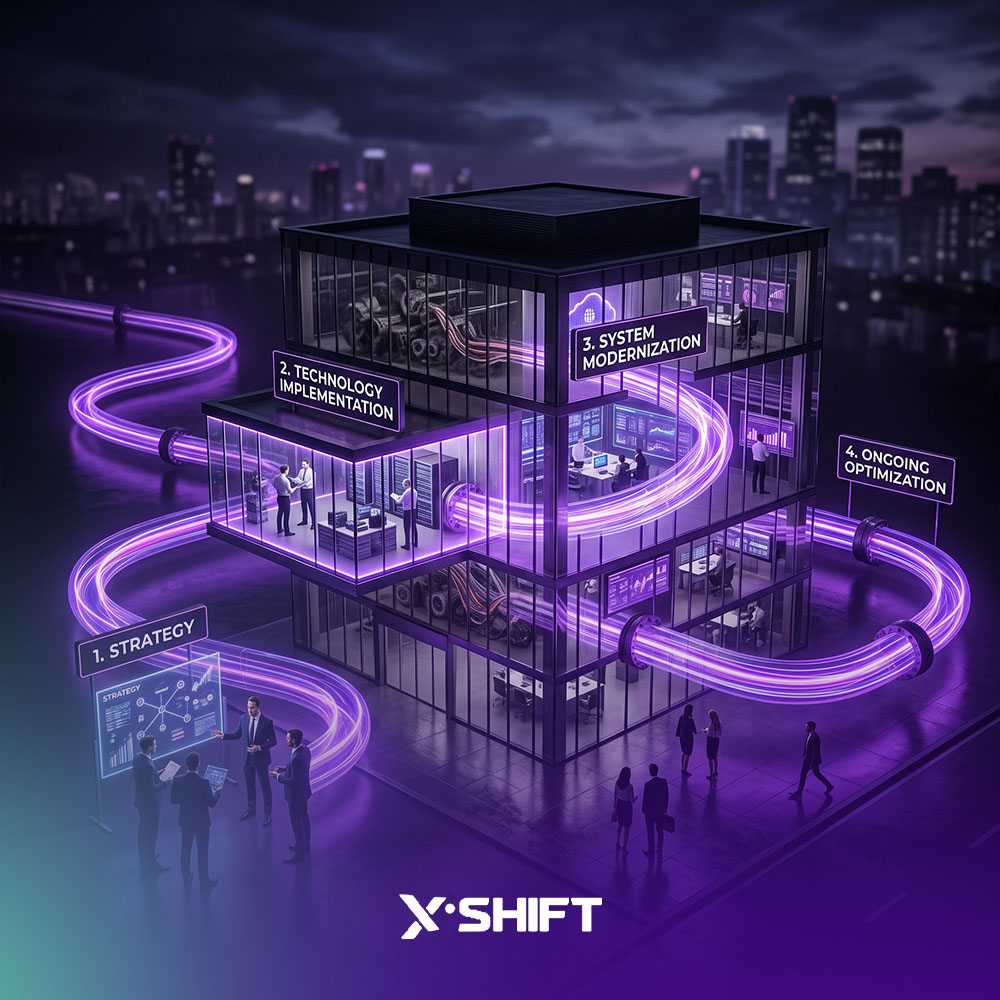
X-Shift provides digital transformation services designed to help organizations move from assessment to execution through a coordinated approach. Its capabilities include support for Qiyas, regulatory and standards compliance, enterprise architecture, data governance, digital applications, and process improvement. This combination helps organizations identify gaps, strengthen digital foundations, modernize operations, and build a roadmap that links technology investments with measurable business outcomes.
Digital Maturity and Qiyas Readiness
X-Shift supports organizations in evaluating digital maturity, identifying readiness gaps, organizing requirements, and building improvement plans. This creates a structured foundation for transformation and helps teams understand what should be addressed first. By connecting assessment findings to ownership, evidence, milestones, and improvement actions, organizations can maintain readiness continuously rather than treating maturity evaluation as a one-time exercise.
Enterprise Architecture and Data Governance
X-Shift helps organizations strengthen enterprise architecture and data governance so transformation initiatives are supported by clearer structures and responsibilities. Architecture improves alignment between business capabilities, applications, and technology, while governance strengthens data quality, ownership, access, and use. Together, these capabilities reduce fragmentation and create stronger foundations for integration, analytics, automation, artificial intelligence, and future digital services.
Process Improvement and Digital Applications
X-Shift combines process optimization with digital application development to help organizations modernize workflows rather than simply digitize inefficient procedures. Teams can identify unnecessary steps, improve handoffs, automate suitable activities, and design applications around actual user needs. This approach improves both operational efficiency and user experience while helping organizations build solutions that can evolve as business requirements and technologies continue to change.
How Do Digital Transformation Solutions Support Customer Experience?
Customer experience often reveals whether transformation is working in practice. If customers face repeated questions or long waits, the underlying journey remains broken regardless of technical advancement. Comprehensive solutions connect customer data, service channels, workflows, and analytics to elevate digital customer experience.
Omnichannel Service Delivery
Customers move across websites, mobile applications, email, chat, and contact centers during a single journey. Operating an omnichannel contact center ensures context is preserved as interactions move from one touchpoint to another, providing support teams with full context.
Personalized Interactions
When customer data is governed and connected, organizations can better understand preferences, service history, and previous interactions. Integrated digital capabilities enable tailored communications and support, reducing customer effort while respecting privacy requirements.
Faster Service Resolution
Automation and integrated data shorten the time between a customer request and its resolution. Deploying AI chatbots and voicebots allows organizations to handle routine inquiries instantly. Understanding the difference between Chatbot and AI Agent and which is best for your business helps choose the right automation level for best AI use cases in customer service and sales.
How Can Organizations Choose the Right Approach?
Selecting digital transformation solutions should begin with a clear understanding of business problems and digital maturity. A structured approach ensures that companies deploy the best customer experience management tools for businesses aligned with real operational needs.
Assess Digital Maturity
A maturity assessment identifies strengths and gaps across strategy, governance, technology, data, processes, and user experience. Leveraging dedicated evaluation solutions like X-Qiyas provides a structured baseline, enabling leadership to track digital progress and meet digital transformation measurement benchmarks.
Prioritize Business Value
Roadmaps should prioritize initiatives according to expected impact, feasibility, risk, and compliance. Rather than transforming everything at once, organizations should focus on high-impact areas, mapping out how to build a successful customer journey from first touchpoint to loyalty using best customer experience strategies.
Measure Progress Continuously
Every initiative needs defined outcomes before implementation. Organizations should know how to measure CSAT and NPS easily alongside operational metrics like processing speed and automation rates to evaluate performance continuously.
How X-Shift Delivers Digital Transformation Solutions
X-Shift provides digital transformation solutions designed to connect assessment, governance, architecture, data, applications, and process improvement within one transformation approach.
Digital Maturity and Qiyas Readiness
X-Shift supports organizations in assessing maturity, understanding requirements, identifying gaps, and building improvement plans. This structured approach helps teams assign responsibilities, organize evidence, and track progress effectively.
Enterprise Architecture and Data Governance
X-Shift helps organizations develop enterprise architecture and establish data governance practices that support coordinated transformation. Architecture provides visibility into system relationships, while governance strengthens data ownership, quality, and security.
Process Optimization and Operational Enablement
X-Shift combines process analysis with digital application development and CX management. Organizations can integrate a robust CRM & ticketing system, knowledge management, and automated quality assurance to optimize internal workflows. Companies building contact capabilities can also learn how to build a professional call center system for your company.
Next-Gen Technologies & Arabic Support
To drive localized innovation, X-Shift integrates computer vision and Arabic-first conversational AI, allowing enterprises to deliver tailored, cutting-edge services across diverse market segments.
To turn your technology investments into measurable, long-term business value, explore our comprehensive CX solutions or contact us today to speak with an X-Shift expert.
Why Choose X-Shift for Digital Transformation?
Organizations looking for digital transformation services need a partner capable of connecting strategy with implementation. X-Shift brings together transformation, customer experience, artificial intelligence, and managed service capabilities, allowing organizations to address interdependent requirements through a more coordinated approach. This helps reduce the gaps that can appear when architecture, data, process improvement, applications, and operational support are handled as unrelated projects.
An Integrated Transformation Approach
X-Shift supports multiple layers of transformation within one broader framework, from maturity assessment and compliance to architecture, governance, applications, and process optimization. This integrated model helps leadership understand how initiatives depend on one another and how each project contributes to business objectives. It also provides a stronger foundation for prioritizing investment and managing transformation as a long-term capability rather than a series of disconnected implementations.
Flexible Solutions for Long-Term Growth
Every organization has different processes, maturity levels, regulatory requirements, and technology environments. X-Shift tailors its approach around these realities, helping organizations define priorities and build solutions that can scale. The focus is on improving current operations while creating flexibility for future innovation, automation, new digital services, and evolving customer expectations without introducing unnecessary complexity.
For organizations seeking to modernize operations, strengthen data governance, improve service delivery, and build a scalable digital foundation, X-Shift provides digital transformation services that connect assessment, strategy, architecture, processes, data, and technology within a practical roadmap designed to deliver measurable and sustainable improvement.