
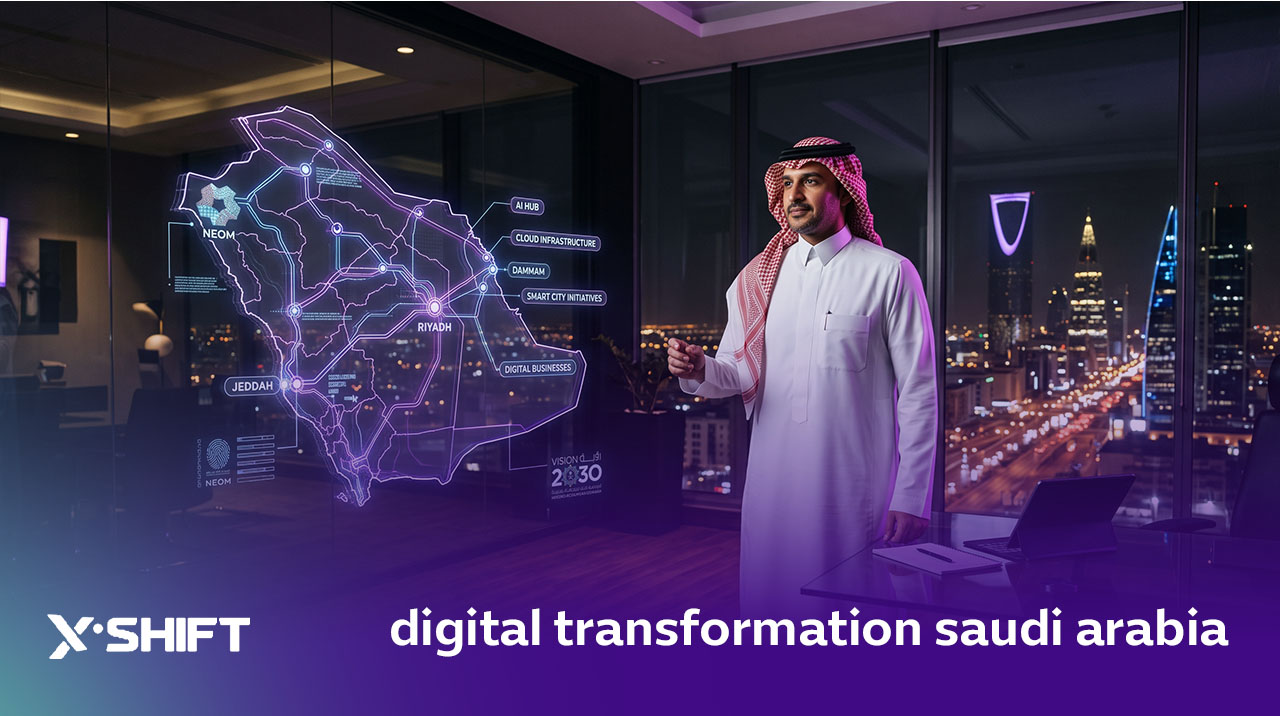
Digital Transformation in Saudi Arabia: Guide to Maturity 2026
Saudi Arabia is moving rapidly toward a more connected, data-driven, and technology-enabled economy. For public and private organizations, this shift creates both major opportunities and new expectations around efficiency, service quality, governance, and innovation. X-Shift supports digital transformation in Saudi Arabia initiatives through an integrated approach that connects strategy, digital transformation measurement, enterprise architecture, data governance, process optimization, and digital applications to help organizations turn technology investment into measurable business value.

What Does Digital Transformation Mean in Saudi Arabia?
Saudi Arabia’s digital transformation landscape is broader than adopting new software or moving services online. It reflects a long-term change in how organizations design processes, manage information, serve customers, and make decisions. Saudi Vision 2030 has reinforced the role of digital capabilities in building a high-performing economy and government. You can explore Saudi CX & Digital Transformation Market Trends 2026 to understand the evolving ecosystem and review successful digital transformation examples in Saudi Arabia that showcase sustainable innovation.

Aligning Technology With Business Strategy
Successful transformation starts with clear business priorities. A digital transformation program should identify the outcomes an organization wants to achieve before selecting tools. These outcomes may include faster service delivery, higher productivity, stronger compliance, or an enhanced digital customer experience. Connecting each technology initiative to a measurable objective reduces fragmented investment and ensures strategic value.
Moving Beyond Simple Digitization
Replacing paper forms with electronic versions is useful, but it does not automatically transform an organization. Teams must examine the entire process, remove unnecessary steps, integrate systems, and avoid common mistakes that ruin customer experience and how to avoid them. Redesigning journeys prevents reproducing old complexity inside new technology and creates opportunities for real-time visibility and seamless collaboration.
Why Is Digital Transformation Important for Saudi Organizations?
The momentum behind digital transformation is changing expectations across government, financial services, healthcare, and retail sectors. Organizations need greater efficiency, stronger governance, and faster access to reliable information. A well-designed program helps address these needs together while leveraging managed services for operational continuity.
Improving Operational Efficiency
Digital workflows reduce repetitive manual tasks and shorten approval cycles. Process optimization should happen before automation so that inefficient procedures are not simply reproduced electronically. Implementing 10 ways to boost customer satisfaction for companies alongside internal optimization allows teams to focus capacity on high-value, analytical activities.
Enhancing Customer and Beneficiary Experience
Customers expect services to be accessible, simple, and consistent. Digital transformation enables organizations to improve customer experience by connecting websites, applications, and back-office systems. When data and processes are integrated, organizations can reduce friction and deliver personalized support based on historical context.
Strengthening Agility and Resilience
Markets and regulations change quickly. Roadmaps should build adaptable processes and scalable technology foundations while maintaining the importance of cybersecurity for businesses in 2026. Cloud capabilities, integrated data, and automated workflows ensure operational continuity as organizational needs expand.
What Are the Core Pillars of Digital Transformation?
A sustainable digital transformation Saudi Arabia program requires several capabilities to work together. Technology is only one part of the equation. Organizations also need governance, reliable data, well-designed processes, appropriate architecture, skilled teams, and clear measures of progress. Ignoring one of these areas can limit the value of otherwise strong technology investments and create new operational or compliance challenges.
Digital Maturity and Measurement
Before designing a roadmap, organizations need a realistic understanding of their current capabilities. Digital maturity assessment evaluates areas such as strategy, governance, technology, data, processes, and user experience. For digital transformation Saudi Arabia programs, maturity measurement helps identify gaps, establish a baseline, prioritize initiatives, and monitor progress over time. It also gives leadership a structured way to compare current performance with target capabilities instead of relying on broad or subjective assessments.
Enterprise Architecture
Enterprise architecture connects business strategy with processes, applications, information, and technology infrastructure. In digital transformation Saudi Arabia, this discipline is especially important when organizations manage multiple systems, vendors, and transformation initiatives at the same time. A clear architectural view can reduce duplication, improve interoperability, guide technology investment, and ensure that new platforms fit into a coherent long-term environment rather than becoming another isolated system.
Data Governance
Digital services depend on trustworthy and accessible data. Addressing data ownership, quality, security, and classification provides a reliable foundation for advanced tools like agentic AI and analytics. Utilizing what is voice of customer VoC and how it improves CX and social listening ensures data reflects real user feedback.
How Can Organizations Build an Effective Transformation Roadmap?
An effective roadmap translates strategic goals into a manageable sequence of initiatives. Organizations can prioritize changes that create the greatest value, leveraging best customer experience management tools for businesses to track performance indicators.
Assess the Current State
Documenting the current environment—including processes, applications, data, and user journeys—helps identify operational pain points. This assessment provides a baseline for measuring improvement and applying best customer experience strategies, ensuring decisions are not driven solely by temporary trends.
Prioritize High-Impact Initiatives
Not every digital project requires the same urgency. Ranking initiatives by impact, feasibility, and risk allows teams to combine quick wins with long-term foundational programs. This structure helps map out how to build a successful customer journey from first touchpoint to loyalty.
Measure and Improve Continuously
Transformation is an ongoing cycle. Organizations should establish clear metrics, knowing how to measure CSAT and NPS easily to evaluate user satisfaction, service speed, and productivity over time.
What Role Do Data, Automation, and AI Play?
The next stage of digital transformation relies on turning connected data and digital processes into intelligent action. Combining clear processes with omnichannel customer experience strategy creates frictionless user interactions.
Process Automation
Automation can support approvals, routing, notifications, classification, data validation, and many other repetitive activities. In digital transformation Saudi Arabia projects, the best candidates for automation are processes with clear rules, high volume, and measurable delays or errors. Organizations should simplify these processes before automating them, ensuring that technology removes friction rather than accelerating unnecessary steps that should have been eliminated.
Automation streamlines routing, validation, and approvals. Organizations can integrate AI chatbots and voicebots to handle repetitive inquiries. Understanding the difference between Chatbot and AI Agent and which is best for your business helps in selecting the right tool for best AI use cases in customer service and sales.
Advanced Analytics and Computer Vision
Deploying advanced analytics and computer vision technologies allows organizations to analyze large data sets, predict demand, and enhance security. Leveraging Arabic-first conversational AI ensures localized and natural customer engagement across digital touchpoints.
Artificial Intelligence and Advanced Analytics
AI can help organizations analyze large data sets, understand customer interactions, predict demand, identify anomalies, and automate selected decisions. Within digital transformation Saudi Arabia, these capabilities can create value across service delivery, operations, customer experience, and management reporting. Successful adoption still depends on governance, high-quality data, human oversight, and clearly defined use cases so innovation remains aligned with business needs and organizational responsibilities.
How Does X-Shift Support Digital Transformation in Saudi Arabia?
X-Shift supports organizations by connecting strategic planning with execution. Its digital transformation portfolio encompasses assessment, compliance, enterprise architecture, process optimization, and CX solutions.
Digital Maturity and Qiyas Readiness
X-Shift assists organizations in preparing for national assessments via the X-Qiyas platform. This tool enables leadership to track digital maturity, manage gap analyses, and maintain continuous readiness for regulatory standards and customer experience management requirements.
Enterprise Architecture and Data Governance
X-Shift supports enterprise architecture using established frameworks and helps organizations strengthen data governance practices. These capabilities are central to digital transformation Saudi Arabia because they provide structure for how processes, applications, technology, and information work together. Better architecture and governance can reduce duplication, improve integration, clarify ownership, and create stronger foundations for analytics, automation, AI, and future digital services.
Process Optimization and Digital Applications
Technology delivers more value when the process behind it is designed effectively. X-Shift helps organizations analyze workflows, remove unnecessary steps, introduce automation, and develop digital applications that support business requirements. This approach allows transformation initiatives to improve both internal efficiency and user experience while creating solutions that can evolve as operational needs, regulations, and technology capabilities continue to change.
Why Choose X-Shift for Your Transformation Journey?
Organizations looking for a digital transformation Saudi Arabia partner need more than technology implementation. They need an approach that connects business objectives, compliance, architecture, data, processes, and measurable outcomes. X-Shift combines these areas within a broader portfolio of digital transformation, customer experience, AI, and managed services, helping organizations build solutions that address current priorities while creating a stronger foundation for future growth.
A Business-Led Transformation Approach
X-Shift focuses on aligning technology initiatives with organizational goals rather than treating technology adoption as the final objective. This helps teams define expected outcomes, understand dependencies, and select solutions that support real operational needs. The approach also encourages continuous review so transformation can adapt as the organization grows, new technologies emerge, or regulations and customer expectations change.
Integrated Capabilities for Long-Term Growth
Because transformation touches multiple areas of an organization, an integrated approach can reduce gaps between strategy and execution. X-Shift combines expertise in transformation, customer experience, AI, data, infrastructure, and managed services, allowing organizations to address interdependent requirements through a more coordinated roadmap. This can support scalability, service improvement, stronger governance, and a clearer path toward sustainable digital maturity.
For organizations seeking to accelerate digital transformation in Saudi Arabia while maintaining a clear connection between technology and business value, X-Shift provides the expertise and integrated capabilities needed to assess the current state, establish priorities, strengthen digital foundations, and turn transformation plans into measurable, scalable initiatives.
To further elevate operations, X-Shift provides solutions like CRM & ticketing system, knowledge management, and automated quality assurance. Teams looking to streamline communication can deploy an omnichannel contact center by learning how to build a professional call center system for your company.
If your organization is ready to accelerate its digital transformation journey in Saudi Arabia, contact us at X-Shift to build a scalable, future-ready digital ecosystem.